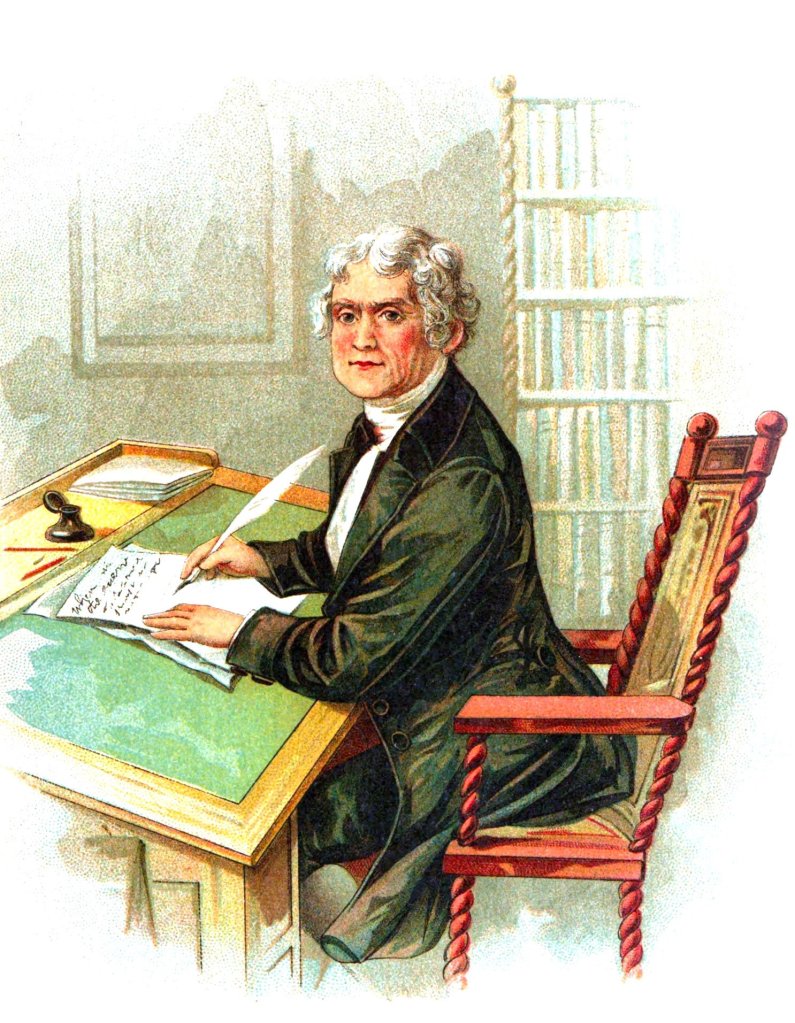
The “Revolution” of 1800
All the way back when Washington was president, and even before that, when the Federalists were not even a political party yet, and they were just a faction, the Federalists had a lot of support from a majority of the country. The Federalists won the largest margins with voters in the upper or middle classes and voters of English descent.
However, the lower class did not support the Federalists, or at least by as wide margins as the upper and middle classes. However, this was the largest segment of the population at the time, and the Federalist numbers began getting weaker and weaker. Many lower-income households only supported the Federalist candidates in an election, simply because Washington, whom they regarded as the great “Father of the Country”, recommended them.
But then, on December 14, 1799, Washington passed away unexpectedly after contracting acute laryngitis, essentially a really severe cold. (In the modern-day, doctors are able to cure this disease.) With that, the country changed forever.
However, many in the lower class had already turned away from the Federalists even before Washington’s death, partly because of the media. As covered in the last blog post, the Democratic-Republican media painted the Federalists out to be a movement intent on making America a monarchy and turning the US into a puppet of the British Empire once again. This, of course, was not true at all, but people (even today) believe what they hear.
In reality, the Federalist Party and the men behind it (Washington, Hamilton, Marshall) held a strong record for success. However, this success came at a price, and this price sometimes frustrated the common man. The Federalists limited the common man’s political power because they feared the common man would be easily manipulated by tyrants, who used them to win elections and political influence. They implemented taxes to help fund the government, including a whiskey tax (which caused a brief rebellion) and tariffs, which drove many Southerners away from the party. They centralized political power and expanded federal influence to use the money collected through taxes to fund things like infrastructure projects, which, again, made many Southerners mad, because a majority of infrastructure projects were in the North. However, on the opposite side, Jefferson and the Democratic-Republicans promised to keep the prosperity and success of the Federalists while getting rid of the costs. Many Federalists turned to the opposing side because of some questions like these:
Did the United States not stand for equality among men? Why should this minority of the population, despite their immense qualifications for the jobs they had, hold such power over us, the working majority?
Why do we have to pay taxes? I thought we fought a war against taxation?
And what’s this about the “federal government”? Why do I care about what happens in Massachusetts when I live in Virginia?
Thomas Jefferson believed that the Federalists, at the end of the day, were not true representatives of true republicans. Rather, they were rich aristocrats who wanted to establish a one-party unitary state by not having parties at all.
Jefferson truly believed that the Federalists had two ways of doing this: 1) either prevent any rival political parties from forming or 2) simply jailing any rival opposition factions. When President Adams signed the Sedition Acts, Jefferson believed that the Federalists had chosen Option 2. Basically, the Sedition Acts made it illegal to say anything that was false or misleading and critical of the government. Jefferson viewed this law as an unconstitutional overstepping of federal authority, wrote resolutions in both Kentucky and Virginia condemning it and essentially saying that states had the right to overturn the law if they wanted to (which they didn’t), and campaigned against it in the election of 1800.
Jefferson believed that the law marked the beginning of an oppressive government and the end for democracy, and he believed that the only way to save America was to achieve a “revolution” against the Federalists, but one that was not violent, instead through the people’s vote. Combine Jefferson’s mass rallies across the country and the pro-Democratic Republican media, and you have a recipe for winning. Jefferson won the highest turnout in the country yet, and defeated Adams in a landslide. The Democratic-Republicans would dominate elections for 30 years, while the Federalists would eventually wither and die out. The Federalists were out of power for good, and now, Jefferson could begin enacting his radical agenda to reshape America.
Thomas Jefferson Biography
Jefferson was born on April 13, 1743, on one of his family’s plantations, in Virginia. His family was pretty rich and afforded to send him to school and then college. Jefferson was well, extremely smart at academia, and quickly became an extremely successful student.
His biggest strength was his ability to understand and memorize information very easily. His biggest weakness, like so many people, was that he was easily distracted and loved being extravagant, maybe a little too extravagant. In fact, he spent the entire first year of college partying off like it was crazy time, and then doubled his workload his second year to compensate for his bad grades the first year.
Now, in the previous post, we discussed that Washington didn’t really have any formal education, but instead learned from first-hand experiences and trial and error. Jefferson was, well, the exact opposite. He learned stuff by reading books. His favorite genres were law, politics, and philosophy. He once wrote that literature was his life and that he “could not live without books.”
Jefferson decided to enter politics (because how else could he become the president), and he kind of developed a bad reputation. He was essentially an unrealistic dreamer. The things he proposed were often extremely radical, and were not really, well, realistic, and were often rejected by his more, well, sane, colleagues.
However, despite this, Jefferson was chosen to write the Declaration of Independence by none other than John Adams (???). When the Declaration was written, Adams and other Founding Fathers were shocked. Jefferson rambled a lot in the document, and included really radical language. Adams essentially rewrote the document to get rid of these ramblings, so the idea that the Declaration was purely written by Jefferson is extremely misleading and false. Jefferson only provided the layout, but a majority of the words were written by other members of the convention like John Adams and Benjamin Franklin.
Another myth about Jefferson was that he played a major role in the war, but … he really didn’t. After “writing” the Declaration, he would spend his time in his native home state of Virginia, where he would spend his time writing the state Constitution (and he actually wrote it this time) and serving as Governor of the State.
It was around this time that Jefferson began an affair with his own slave Sally Hemings, who herself was the product of an affair and was actually Jefferson’s wife’s half-sister. (Man, this is messed up!) Reports suggest that the sexual relationship between Hemings and Jefferson may have even begun when Hemings was 14 years old. Jefferson and Hemings would go on to have 8 kids together, all of whom would either die in infancy or would be enslaved by their own father. Despite Jefferson defendants claiming that the kids were not Jefferson’s, a 2018 DNA study and some critical thinking prove that Jefferson had in fact fathered the 8 kids with Sally Hemings. (What the heck, Jefferson!)
Once the war was over, Jefferson would be made the Minister to France until the French Revolution broke out in 1789. As I said in the previous post, Jefferson clearly supported the French Republicans, even helping them write their own mini-Declaration of Independence, called the “Declaration of the Rights of Man.” He caused so much diplomatic trouble that Washington called him back to the US where he would be made Secretary of State. He would clash with Alexander Hamilton, the Secretary of the Treasury, do some shady stuff to undermine Washington’s rule, and ultimately resign as Secretary of State in 1793 after the stuff was exposed.
So let’s talk a little bit more about Jefferson’s ideology itself. It can be summed up in two words: egalitarian liberty. Or in simpler terms: decentralization, decentralization, decentralization. Jefferson believed that the country must be decentralized to preserve the local freedoms from the rule of the capital, which he saw as far off and disassociated from the realities of the day. He believed that the common landholding man should hold an equal degree of power and the rich aristocrat.
Now, both Jefferson and the Federalists believed that all citizens in the country should have equal protections in the Union. The difference came as in who should hold the most power. The Federalists believed the wealthy elite should hold the power because they themselves were above corruption and they would preserve democracy for the rest of the country. Jefferson disagreed. He believed that the wealthy would simply take all the power from themselves. Now, Jefferson also didn’t want the hand to go to the hands of the uneducated masses, sharing the belief they could easily be manipulated by candidates through disinformation techniques. Instead, Jefferson believed that power should be in the hands of the agrarian yeomen class. In Jefferson’s mind, these farmers were completely self-sufficient and didn’t need any outside support from the government. They had a physical stake in the country and thus were the only ones that were interested in preserving freedom because they were free personally because of their tireless efforts.
The funny part is that Jefferson himself could not live to his standard. He was in debt for a good portion of his life, spent his money like a billionaire, and all the while claimed to be a mere tobacco farmer to his supporters. (What a hypocrite!)
Despite the fact that he criticized aristocrats, he was one himself. He loved fancy food. He loved reading philosophical literature. He spent many hours writing and researching topics that average tobacco farmers wouldn’t have cared about.
The crazy part to me is that he not only lied to the public that he lived a modest life, but he believed this lie himself. I just don’t understand how a man who was worth $286 million at the height of his life thinks he was a common man. If I was worth that much, I certainly wouldn’t.
Now, I know that everything I just said speaks poorly of Jefferson’s character, but it is not to say that he didn’t have some good ideas in his agenda. His policies would have a long-lasting impact, with future administrations largely expanding upon Jefferson’s ideals rather than changing it until the Civil War. This would make the agrarian South the dominant political force in the country for 60 years, completely changing American history forever.
As I just said a little while ago, Jefferson’s voter turnout was completely unprecedented. There were many strategies Jefferson employed, including campaigning aggressively and holding massive rallies, appealing to the common man through messaging, and using the Democratic-Republican media to essentially create a message and distribute this message to people across the country. Despite the fact that the Federalists carried support from twice as many publishers as the Democratic-Republicans, the Democratic-Republican media was more connected and was able to spin 1 message, not 1,000: Thomas Jefferson stands for the working man, while President Adams stands for the rich elites.
With this, Thomas Jefferson would win the election of 1800 and would now radically change the direction of the country. This, of course, made many Federalists fearful and concerned about what would come. After all, the Federalists had ruled the country from the beginning, and this was the first transition of power from one party to the next.
Now, before Jefferson took office, Adams tried to do whatever he could to make sure that Jefferson wouldn’t change all of what he had done. Maybe, he thought, the Federalists could take power back in a few years. That would never happen. There was even talk in the North to secede from the Union later on, but this would never occur.
In a matter of weeks, the same radical who had refused to attend Washington’s funeral simply because he was the member of an opposing party was now the leader of the country. But it wouldn’t stop there.
Before Jefferson, the Democratic-Republicans were somewhat of a minor faction in Congress, and they never carried more than 55% of seats. But after Jefferson became president, they maintained a 2/3ths supermajority for 25 years! (That’s crazy.)
The Federalists could do nothing but watch. The country would be in the hands of the Democratic-Republicans for a long time, until they themselves died out and dissolved as a party.

Thomas Jefferson Administration
Jefferson pretty much undid all of the Federalist policies of his predecessors. Jefferson carried out his decentralization agenda, reducing federal power over the country and giving a lot of power back to the States. He also reduced the size and scale of the military dramatically, so that it would only be used defensively and would not antagonize other nations. The Sedition Acts were also repealed.
On the bright side, however, Jefferson established West Point Military Academy, one of the biggest academies in the world to this day, significantly reduced the national debt by cutting government spending, and purchased the territory of Louisiana from France, doubling the size of the entire nation. Congress would authorize an expedition to explore this new territory, led by the now-famous Merriwether Lewis and William Clark.
In his later years, Jefferson also signed the Embargo Act, which basically stopped all trade with all foreign nations because many countries, including the British, the French, and pirates from North Africa were violating US trade. However, the act caused a complete collapse of the economy, and the law was repealed just two years later.
 History Explained
Leave a comment