Now, although Jefferson was done with his 8 years in office, his party, the Democratic-Republicans would continue to be the party in power at this time, and the next three presidents that followed Jefferson were all Democratic-Republican: James Madison, James Monroe, and John Quincy Adams, continuing Jefferson’s agenda and policies. Madison and Monroe served two terms, while Adams barely even won his first one.

James Madison Administration
Madison had co-founded the Democratic-Republican Party with Jefferson and continued Jefferson’s policies, essentially 16 years of the same administration. However, after the War of 1812 ended, Madison realized that a strong central government, economy, and military was actually necessary to the nation’s security and desperately tried to promote Federalist policies in the last few years of his presidency, but he ultimately failed in doing so.
However, this was not a big surprise to anyone. Madison used to be a Federalist, co-authoring the Federalist Papers with John Jay and Alexander Hamilton, and was much closer to Washington than Jefferson was. This foreshadowed what would occur later down the line.
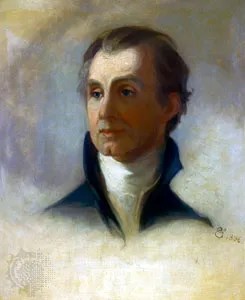
James Monroe Biography
Monroe was, in my opinion, a remarkable president. Yes, he’s part of Jefferson’s Democratic-Republican Era, but I think he should be discussed more than he is for his unique character and contributions to the Democratic-Republican party.
Monroe was born on April 28, 1758, in New York. His family had decent money, owning land and enslaved slaves, showing that they had a moderate level of wealth for the time. However, Monroe had to do a lot of laborious work throughout his early life.
He spent 4 times as long working on his family farm than he did on his school. Then, his parents both died when he was just 16 years old. He dropped out of school and focused on farming full-time to support himself and his younger siblings. Remember, at 16 years old, Jefferson went off to college so that he could party with his peer students and his professors, so this was a massive difference in what both were doing.
Monroe’s uncle felt sorry for him, and he wanted his nephew to succeed in life, so he lent him a hand and helped him go to college and get proper education. However, when the Revolutionary War broke out, Monroe decided to drop out of college to fight for his country.
Unfortunately, Monroe would be struck by a musket ball in the shoulder that severed his artery. His life would be saved by a doctor who stopped the bleeding by pressing a finger into his wound. He would recover from his injuries and return to combat, serving during the Battle of Brandywine(September 1777) and the Battle of Germantown (October 1777) and was promoted to Captain for his bravery. After the war ended, Monroe got a new tutor. Guess who….
If you guessed Thomas Jefferson, you’re right! Monroe was literally the representation for the perfect self-sufficient agrarian American that Jefferson idealized. He had a modest and disciplined lifestyle, was part of the independent yeoman farmer class Jefferson championed, and was known for his humble and unpretentious character. These were all qualities that the Democratic-Republicans admired in a leader.
Monroe was smart, shown by his military strategy, diplomatic acumen, political vision, and legal & intellectual contributions. He was strong, famous for his perfect posture and tall height. He was independent and self-sufficient. His military service and belief in Democratic-Republican ideology proved he was loyal and dedicated. He was the perfect Democratic-Republican politician, and to Jefferson, the perfect man to carry on his legacy.
However, there was a very big difference between Jefferson and Monroe. Jefferson was rich, famous, and powerful. He had never suffered from want, because he got everything he wanted. He spent days wanting to have a simpler life. On the other hand, Monroe was a labourer in his early life. He knew how horrible and boring it would be for him to do manual labor his whole life.
Now, for a regular man, doing manual labor and farm work could’ve been enough. Had Monroe been a regular man, he would’ve gotten nowhere. He would’ve been stuck toiling the fields for the rest of his life. History would not have remembered him.
But Monroe was not a regular man. He was not fine with farming. He was not fine with being forgotten. He wanted to do something, go somewhere, be someone. But that path to being the top would be rocky.
Jefferson and Monroe would work together to advance Democratic-Republican ideals. Jefferson’s wealth and status launched Monroe, a common agrarian man, into politics. They were great friends and close neighbors. Monroe once wrote to Jefferson in a letter, “I feel that whatever I am at present in the opinion of others or whatever I may be in future has greatly arisen from your friendship.” Quite the dynamic duo, right?
Monroe, however, faced several early political missteps before solidifying his legacy. He initially opposed the U.S. Constitution, which made him unpopular, lost a Congressional bid to the House of Representatives to James Madison, and strained U.S.-France relations during his time as Minister to France, which forced President Washington to recall him. Despite this, he stood by Jefferson’s side through it all, and did what Washington did, watched and learned, playing a pivotal role in negotiating the Louisiana Purchase, which doubled the size of the United States.
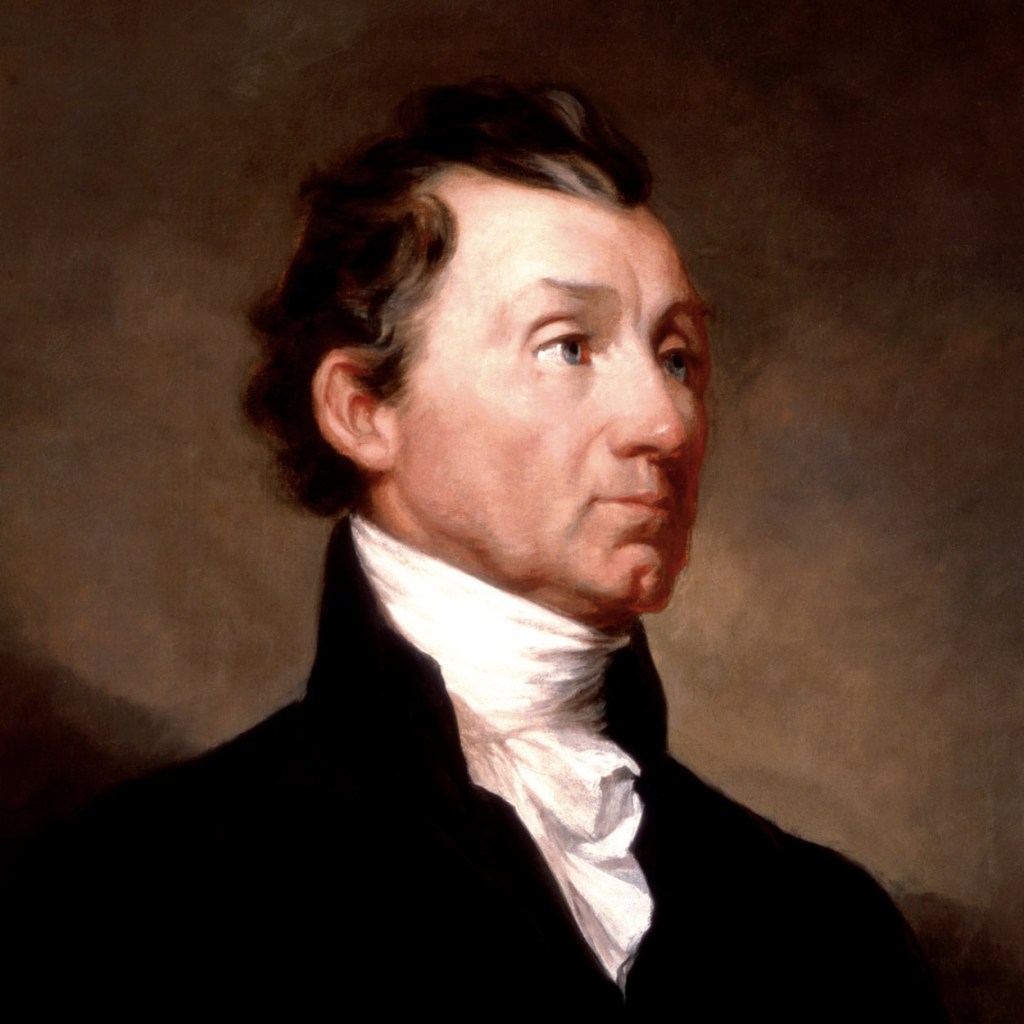
James Monroe Administration
Now, Monroe was very pragmatic in his policies as President, incorporating some policies from the Federalist Party into his own. This was partly because he recognized that the Federalists were no longer a prominent political party, and they would dissolve under his watch, essentially turning America into a one-party state.
For example, Monroe implemented major infrastructure projects during his presidency. He expanded the Cumberland Road all the way into Ohio, which became the first major highway built by the federal government. In the wake of the War of 1812, he also emphasized national defense, authorizing projects such as military roads and fortifications along the Atlantic coast. He also encouraged the construction of the Erie Canal and began looking for more canal and waterway opportunities connecting major cities.
Monroe’s shift towards infrastructure development, protective tariffs, and even a National Bank, all major Federalist policies, all led many prominent Federalists to either join the Democratic-Republican party or agree to cooperate with them in what became known as the “Era of Good Feelings.” Some of these Federalists include John Quincy Adams, Richard Rush, Harrison Gray Otis, Rufus King, and Daniel Webster. The loss of these figures ultimately drove the Federalist Party to complete extinction.
Now, Monroe did this on purpose. The Democratic-Republicans had dominated national politics for around 20 years by this point. He had an idealistic vision of Democratic-Republicans and Federalists working side-by-side to advance an agenda the whole country agreed with without political parties even existing. Of course, he only advocated for this because the country was pretty much completely entrenched in the ideology of the Democratic-Republicans by this point. And while it initially seemed Monroe’s vision would come true, it all soon came crashing down.
In foreign policy, President Monroe issued the now-famous Monroe Doctrine, essentially warning European powers of future colonization attempts. This made clear that the US would support anti-imperial and republican movements across the Western Hemisphere. This would set the stage for American imperial dominance of the Western Hemisphere in the early 1900s that still exists today.
However, just as it seemed that everything was going to be fine, and Monroe’s vision for the future of the nation was coming true, everything completely changed in the next election, shocking everyone.
 History Explained
Leave a comment