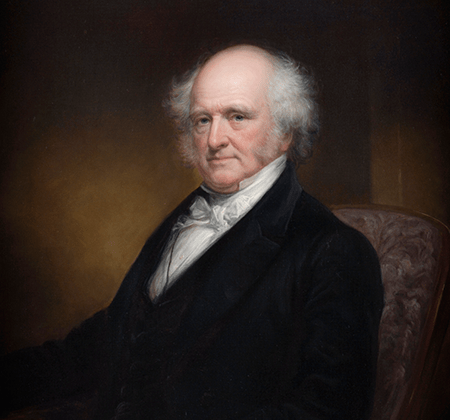
Martin van Buren Administration
Martin van Buren, the president after Jackson, was an elite Northerner from the upper class, but he was different from other Democratic-Republican elites in that he was not easily corruptible and believed in the original values of the party. Just like Jackson, van Buren recognized the corruption and nepotism of the elites in the party, and helped build a new political party, the Democratic Party, with Jackson to challenge the elites’ rule, then being appointed by Jackson to be Vice President after Calhoun’s resignation.
Van Buren won the presidency after Jackson, and his presidency was, to put it frankly, pretty boring, at least compared to Jackson; he prevented the US from entering two wars and presided over a serious economic downturn known as the Panic of 1837, which was caused by higher interest rates initiated by Britain and higher foreign demand for American goods than there was supply, but only made worse by Jackson’s dissolving of the Second National Bank, which used to provide financial stability during downturns (Remember!). However, with the Democratic-Republicans dissolving in 1834, a new opposition party was formed against what seen as the tyrannical mob rule of Jackson’s Democrats, the Whigs, founded by former House Speaker Henry Clay, the guy who had denied Jackson his rightful victory in 1824 and received a death threat from him, who would circulate the false rumour that Jackson was responsible for the crisis, a misconception many historians still have today.
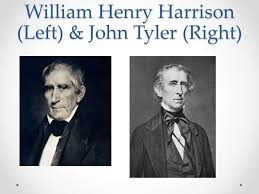
William Henry Harrison/John Tyler Administrations
Despite the fact that van Buren was mostly successful as president, multiple factors, including economic instability, false rumors of Democrat responsibility for that instability, and overall van Buren’s more timid and mild-mannered approach to governing cost him reelection to the Whig candidate, William Henry Harrison, who, just like Jackson, was a war hero, famous for his victory at the Battle of Tippecanoe in 1811, but who was ideologically more Whig and who would essentially act as a puppet for now-Senator Henry Clay. However, in a turn of events no one expected, Harrison died of pneumonia one month into office, with his Vice President John Tyler becoming the chief executive; Tyler was actually a Jackson sympathizer who managed to stall Clay’s Whig agenda for long enough until a Jackson loyalist named James K. Polk could retake the office.
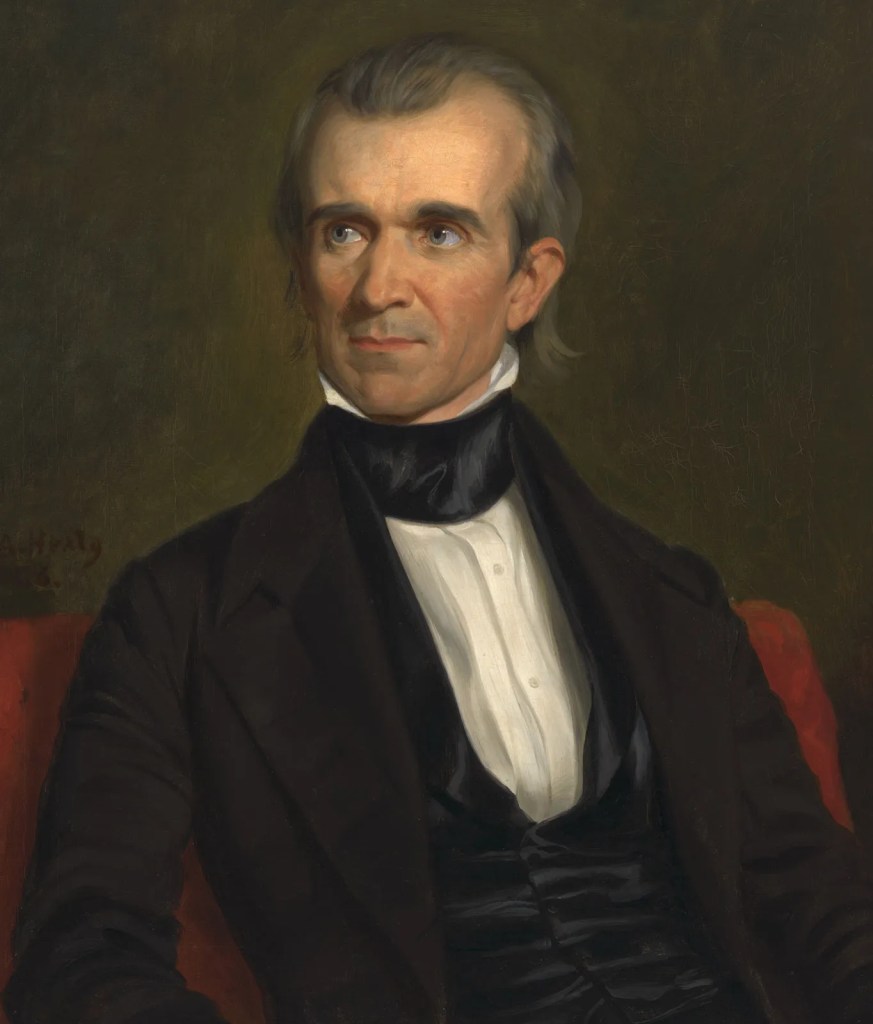
James K. Polk Administration
Polk, a Southerner, was so close to Jackson, being seen as his apprentice, working with him to pass his agenda through Congress, and even adopting many of Jackson’s personal beliefs. After serving as Governor of Tennessee, Polk campaigned in 1844 on what he called his Four Great Measures, and as soon he was president, he set about implementing all four.
- Polk reestablished the Independent Treasury in 1846, a system where federal funds would be held in the government’s own vaults, reducing government reliance on banks and preventing speculation of federal funds but also limiting credit availability and hurting economic growth.
- In the same year, Polk lowered tariffs from 32% to around 25%, which reduced protection for Northern manufacturers and increased reliance on foreign goods by reducing a barrier that had once promoted American self-sufficiency and allowed the government to collect extra revenue.
- Polk negotiated with Britain to divide the Oregon Territory along the 49th parallel, allowing for the creation of Oregon, Washington, Idaho, Montana, and Wyoming.
- Polk further expanded U.S. territory by annexing Texas in 1845 and going to war with Mexico that same year. By 1848, American troops had occupied Mexico City and negotiated the Treaty of Guadalupe Hidalgo. The states Polk had added from this treaty are Texas, California, Nevada, Utah, New Mexico, and parts of Colorado, Oklahoma, and Wyoming, all states which Polk hoped would practice slavery.
Polk is the only president in American history to fulfill all of his promises, including a promise not to run a second term. After all, Jackson, Polk’s idol, had believed that presidents should only serve one term, despite the fact that he served two terms himself as president. The immense stress Polk took on as president would help contribute to his decision not to run for reelection. He would die shortly after leaving office.
Polk’s shift towards the South and pro-slavery politics had made many Northern Democrats really mad. The Northern Democrats didn’t like slavery, but they believed in strict constitutionalism, and, as the Constitution delegated the slavery issue to the states, they tolerated it in the South, while they banned it in northern states, leading to a weird balance of free states and slave states. However, the Northern Democrats pursued policy that was favorable to their more industrial economy … like tariffs, and soon a divide was ensuing within the party.
Uh oh … guess who’s back? Martin’s back. That’s right, former President Martin van Buren, a Northern Democrat, decided to re enter into politics and run on an independent anti-slavery platform, splitting the Democrat vote and handing the election to the Whig candidate Zachary Taylor. It’s important to note that van Buren did this purposely since the Whigs were openly opposed to slavery. However, the Whigs decided to let the issue slide for now so as to, you know, not start a civil war, a decision which would come back to haunt them in the future.
 History Explained
Leave a comment