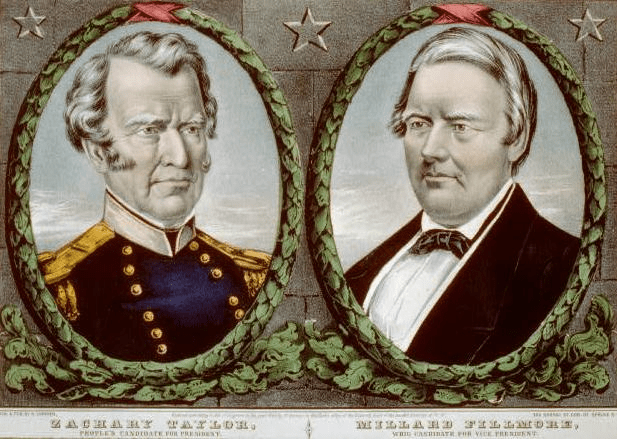
Zachary Taylor/Millard Fillmore Administrations
General Zachary Taylor narrowly won the 1848 election because van Buren split the Democrat vote and that he was a popular Southern general from the Mexican-American War, showing that, once again, the Whig’s strength came from copying Jackson’s personal character (Southern war hero) but having an ideology aligned more with Senator Clay. However, just like the last Whig who was elected to office [William Henry Harrison], Taylor would die just 1 year into his term, with some historians suspecting that he was poisoned.
With that, Vice President Millard Filmore ascended to the office, and his presidency was also kinda boring. He is probably the closest that the Whigs got to a full presidential term, considering that Harrison and Taylor died and Tyler governed more like an Independent, and he decided to compromise with the Democrats on slavery to just narrowly get support for other Whig policies, which only divided the party even further along the Northeast, the radical abolitionists whose only goal was to end slavery, and the Central States, whose main goal was moving the country forward, even if it meant compromising on the issue of slavery. Many historians call Fillmore a Southern sympathizer, even though he actually opposed slavery personally but, just like other Whigs, didn’t want to start a civil war over it. Fillmore decided not to run for a second term, and the Democrats would win the subsequent election.

Franklin Pierce Administration
Under Democrat Franklin Pierce, the North-South divide only became even clearer. Pierce didn’t actually believe that he was ready for president, but was sort of forced into the position by his Democrat colleagues, who believed that a Northerner with pro-Southern (and thus pro-slavery) views would unify the country, but they were very wrong. Pierce would see his own son get nearly decapitated in a horrible train accident where he was thrown off of the train car only two months before being inaugurated, and he would ultimately become depressed and end up an alcoholic for the rest of his presidency.
Now, before I continue, I do want to explain this slavery situation a little bit more and clear up some of the misconceptions surrounding it. Most of the country knew that slavery was morally wrong and wanted to end it, and it really was only in the Deep South that slavery was either considered moral as African Americans were believed to be comparable to animals or that slavery was wrong but it was okay because it allowed the South to continue controlling the government. However, there were the opposite radicals in lower New England, people who demanded that slavery be abolished immediately and the Freedmen to be fully integrated as American citizens. The New Englanders painted slave owners and complicit Southerners as sinners, while painting those who personally disliked the practice but supported it publicly to not start a civil war as traitors. This was the result of the Second and Third Great Awakenings, which created a huge demand for reform and social justice by any means necessary. There were also less radical groups in the abolitionist camp like the Quakers in Pennsylvania and the Scandinavian immigrants in the Far North. The most infamous abolitionist was John Brown, a religious lunatic who believed that God chose him to be the new Moses and lead the slaves to freedom, who went on a murderous rampage of Southern families in Kansas and attempted to lead a genocidal armed slave revolt in the South that failed horribly and led to his hanging. To the Deep South and Lower New England, it was better to let the Union die than to compromise on the position. You were either with them or with the enemy; there was no moderation.
Now, most moderate Whigs and Democrats believed that slavery should be gradually eliminated state-by-state, as the Constitution very clearly says that powers not delegated to the federal government (i.e. the power to restrict slavery) to the states, and that it was illegal to do otherwise. They also agreed that once slavery was abolished, the freed population should be relocated to a separate place so that they wouldn’t be the target of any discrimination or violence, sort of like a Native American reservation, but for African Americans. However, the debate was between whether slavery should be extended out into new states to maintain a North-South balance, with slavery being eliminated over a gradual period of time, the Democrat position, or that slavery be restricted to the South, squeezed, and eliminated more quickly, the Whig position. Unfortunately, the Democrats would essentially be overtaken by the radical Deep Southerners, with moderates either sidelined or being expelled from the party. Remember, Jackson had warned that politics would become increasingly sectional, which would give the pro-slavery Deep South a major voice, but it turned out that the party of the Deep South would become the party he founded. The Democratic Party, the party of states’ rights, agrarianism, decentralization, and democratization, was now essentially the party of slavery.
Now, President Monroe had proposed a solution to this problem: the Missouri Compromise, which stated that all Western lands north of the 36th parallel would become free states, while lands south would become slave, and at the time, the only Western land in that zone was Arkansas Territory. Northerners were content that slavery could no longer expand and it would be squeezed out and eliminated. But then, Polk took over Texas and the Southwest, areas that were below the Missouri Compromise line and thus viable to be slave states, which led to the Deep South, now the voice of the Democratic Party, to call for further invasions of Cuba and Northern Mexico, which would mean even more slave states and would balance out the free and slave states; in response, the North called for the banning of slavery in the new territories west of Texas, which made many Southerners who personally participated in the Mexican American War really mad. President Taylor rapidly granted California statehood on the condition that it banned slavery, which showed the South that the North was willing to break the Missouri Compromise to get what it wanted. He wanted to do the same thing with New Mexico, but then, he mysteriously passed away. President Fillmore passed the Fugitive Slave Act as one of his compromises with the Democrats, which pretty much just reinforced what the Constitution said, that if a slave was to escape a slave state and go to a free state, the free state should do everything in its power to return that slave back to the slave state, but was repeatedly being violated by the abolitionists through the Underground Railroad. Of course, the abolitionists still refused to follow the law, even when the new act introduced punishments for helping slaves escape.
Again, we need to look at this from the perspective of the South as to find out why they eventually decided to secede. We all know slavery is bad, thus helping escaped slaves is good. But let’s look at this from the perspective of the South: imagine you repeatedly lose lots of money, and so does your neighbor, and your neighbor’s neighbor, and so forth. Then you find the people who stole the money, but the people in charge refuse to arrest them, and so does the government that is required to by law. Now, you begin to understand why the South was so mad. With the government doing nothing, they felt they needed to take it into their own hands, a.k.a secede. Meanwhile, the Northerners in the Underground Railroad were being punished for doing the right thing and just trying to help. Soon, this tension would break out into violence.
So the nation’s already very volatile and about to explode. Now, it was in the hands of a pro-slavery alcoholic who’s severely depressed. What did you think would happen?
Pierce would repeal the Missouri Compromise in 1854 and instead allow for the people of the states to vote and choose whether or not to ban slavery, kind of like what the states do with abortion today. Most states were already inevitable free states and slave states, but the one state that could go either way was Kansas. So, both pro-slavery Deep Southerners and abolitionist Northerners flocked to the state, and things began to get ugly, really ugly, so much so that the time was referred to as “Bleeding Kansas.” The violence even spread to the halls of Congress, with a pro-slavery Southerner beating up an anti-slavery Northerner with a cane, and getting away with it. The American justice system!
Pierce, like other pro-slavery Democrats, believed that the radical abolitionists were the greatest threat to national unity. He once said, “I have never believed that actual disruption of the Union can occur without blood; and if, through the madness of Northern Abolitionists, that dire calamity must come, the fighting will not be along Mason’s and Dixon’s line merely.” Yeah, you’re also one of our worst presidents, ever, Franklin.
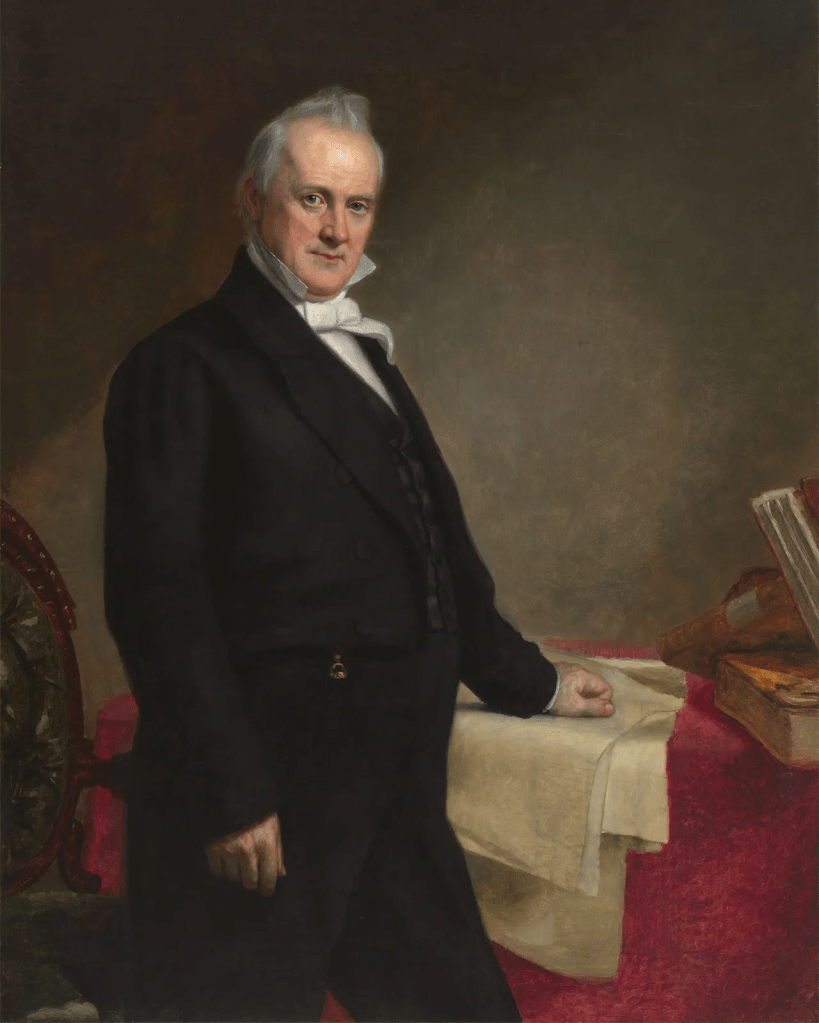
James Buchanan Administration
Buchanan was exactly what the country needed at the time. He was a great leader, a strong leader, and a powerful leader. He was so great, in fact, that he was able to resolve conflicts peacefully and prevent the Civil War and go down in history as the greatest man of all time….
Just kidding. Buchanan couldn’t even get a wife, with his girlfriend running away before their marriage. How was he supposed to run the country well? He was, unfortunately, another Democrat, a representative of the Deep South and their extreme pro-slavery views. He would lower tariffs significantly, attempt to make Kansas a slave state, which would fail, and attempt to incorporate Cuba and Northern Mexico into the Union as slave states, which would also fail.
However, the country was done with slavery, and they wanted to end it, even if it cost 750,000 lives and $100 billion.
 History Explained
Leave a comment