
Modernization & Industrialization
Following the end of Reconstruction, the Radical Republicans lost a lot of their influence across the country, as America had grown tired of the constant anti-Southern and pro-Freedmen rhetoric; Northerners simply wanted to focus on the North and set up the country for success. Southerners wanted to focus on the South, and they became a united voting bloc, the Solid South, who would vote blue for the next 10 presidential elections, all while controlling the House of Representatives. Meanwhile, at the national level, the mostly Republican presidents tried to regain the executive authority lost to Congress during Reconstruction and try to control the now-rampant corruption that almost had made America a plutocracy, a society ruled by the very wealthy.
This was the trend politics followed for the next 3 decades, while, socially, America was changing dramatically. Yes, the North and the South were different culturally speaking, and there were even different divides among regions within them, but, overall, the country was becoming more interconnected via a complex system of railroads that even the common worker could access. In just a few days or even hours, a Northerner could go to the South and vice versa. Both could travel to the West much faster than they would have without the railroads. Business was now at a national, not state, scale.
Urbanization was speeding up, as the time it took to travel between different ends of the city and travel to the city from neighboring towns was now way less than before. The train also caused many other industries to explode, specifically industries that employed a lot of low-skilled workers. After all, if you want more trains and tracks for the train, you’ll need to have more steel, copper, lumber, and iron; you’ll need fuel to power the train, mainly oil and coal. Thus, the train gives rise to the titans of industry. Many of these businessmen didn’t exactly have principles and moral authorities, and most of them used illegal tactics. At the end of the day, these men, for better or for worse, shaped America’s policy, had influence over politicians, and helped construct a new social order.

Presidential Administrations
The president after Hayes, James A. Garfield would focus on tackling the widespread corruption, before being assassinated by a crazy dude who wanted a consulship in Vienna or Paris. Garfield’s successor, Chester A. Arthur would continue fighting corruption, although the only reason he got to where he was is because of corruption itself. Arthur would also implement a 10-year moratorium on Chinese immigration, seeing that there was a huge influx of Chinese immigrants while the national population was rapidly increasing and the Freedmen were still trying to find low-skilled jobs; he also banned any immigrant who might become an expense to the economy. Immigration from the majority of Asia would eventually be banned, and heavy anti-Chinese discrimination would lead to most Chinese Americans simply returning home, making the Chinese share of the total population shrink to less than 0.1%.
Arthur did not run for re-election, due to health concerns, so the Republicans nominated James Blaine as their candidate instead. However, there was a clear divide beginning to show in the party. After the Radicals collapsed, the new divisive issue in the party was patronage or meritocracy? Should positions be handed based on political loyalty or purely on the basis of merit? Most Americans favored the second option, given how much corruption was happening at this time, but James Blaine was a guy who was involved in a multitude of corruption scandals. Meanwhile, the Democrat candidate, Grover Cleveland, had a reputation for fighting corruption and promoted his honesty and dignity in the election, helping him very narrowly win the election by less than 1%, becoming the first Democrat to win a presidential election since James Buchanan in 1856.
As per the Democrats’ states rights tradition, Cleveland would try his best to reduce the power of the federal government and give it back to the states, believing it was both unconstitutional and unhealthy for Congress to hold so much power and for the American public to be so dependent on Washington. He also reduced the high tariffs implemented in 1861. The justification was the Democrats’ support for agrarianism and low tariffs, and his own personal belief for free trade.
Cleveland ran for re-election, but he was defeated by Republican Benjamin Harrison, the grandson of William Henry Harrison, the President who served a month of his term. Harrison would continue on previous Republican policies, restoring the tariffs that Cleveland had lowered, rooting out corruption, and supporting America’s expansion abroad, a momentum for which had faded away for a time because it was being used by the South to expand slavery. Although Harrison had good intentions with his protectionism, they cost him re-election to none other than Grover Cleveland, the first President to serve two non-consecutive terms until Donald Trump.
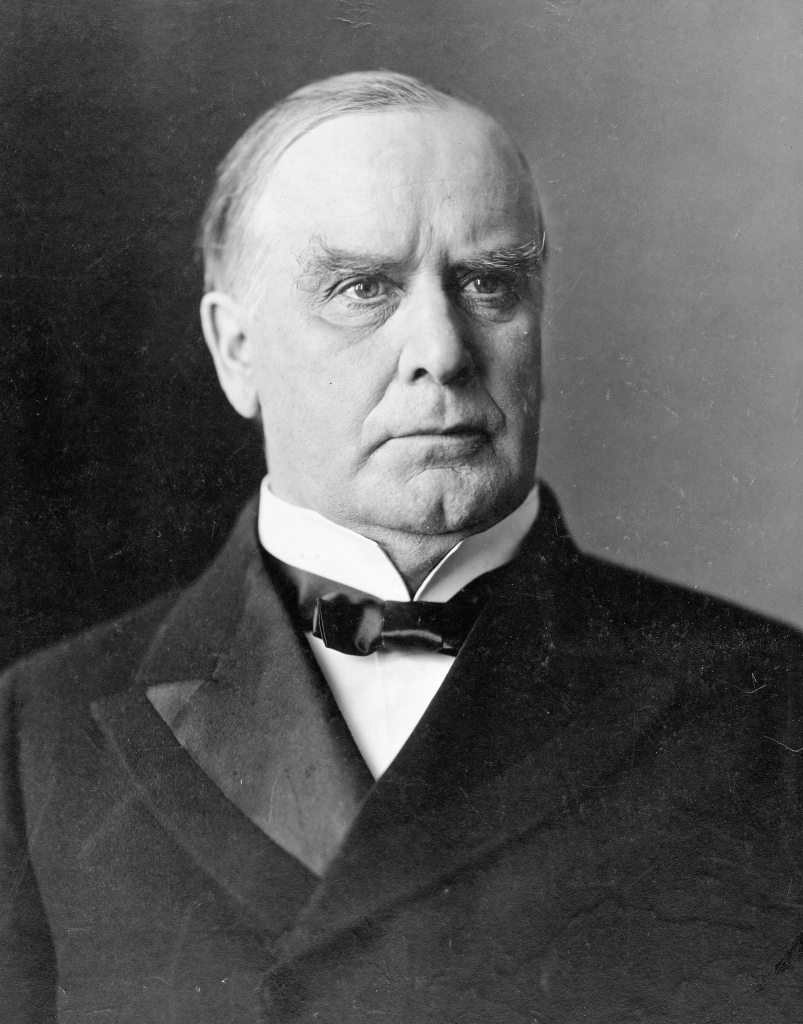
William McKinley Administration
The previous administrations all built up to results under the presidency of William McKinley, under whom America finally began to become not only a united country but the unchallenged superpower of the Western Hemisphere. The previous presidents had built up America’s Navy, a neglected part of America’s military since the Civil War, using the nation’s interconnectivity and industrial might to turn it into the most powerful navy in the world. The economy was prospering, although there was some significant corruption, which bled into the public sector. The previous presidents before McKinley had tried really hard to clean up the corruption, but monopolistic companies still had big sways over individual politicians of the time, adjusting themselves to whatever policies were most popular at the time in order to keep political power. This created a divide in the Republican Party: one faction wanted to represent the businessmen of America, the country’s best and brightest, who had worked their way up to the top, and the other wanted to represent the common working man of America, whose only way to show their priorities was their vote.
McKinley said, “America must avoid the temptations of territorial aggression,” but despite this, his administration quietly looked into any assets or partners in Central America, South America, and the Pacific, to protect our position in the Americas from the rising powers of Imperial Germany and Japan. Hawaii was almost a perfect spot, as it could both protect America’s position in the Americas and help America project influence into the Pacific, which could secure both our military and our trade partners in the region. Following the overthrow of the Queen by American farmers, there were significant calls for both President Benjamin Harrison and President Grover Cleveland to annex the country, although Harrison’s attempts were withdrawn by Cleveland out of principled opposition to imperialism; however, McKinley, recognizing Hawaii’s strategic importance, pushed through and signed a joint resolution annexing the territory in 1898.
McKinley was also very interested in Panama, specifically by building a canal that connected the Atlantic and Pacific Oceans, that would allow for speedily transporting materials from coast to coast by ship, not just through rail. Britain and other European powers were also interested in building a canal. Therefore, if McKinley failed to secure this asset for the United States, it would fall in the hands of some other power that could be hostile to us.
The final spot of interest was Cuba and Puerto Rico, two places that the US had long wanted to annex, as it would secure American dominance over the Caribbean and would give the US access to lucrative sugar plantations and valuable crops; McKinley would launch a war with Spain to take these territories for America. Here, during the Spanish-American War, a politician would make a national name for himself, volunteering himself and his regiment, which he assembled, to fight for his country. McKinley would pick him as his Vice President to boost support for his re-election campaign, which he would win, but he would not live to see it very far. Only a few months into his second term, McKinley would be assassinated by a radical leftist anarchist, and now, this young Vice President, only 42 years old, would be suddenly thrust into the office of the Presidency, and he would make sure that he would change America forever.
 History Explained
Leave a comment