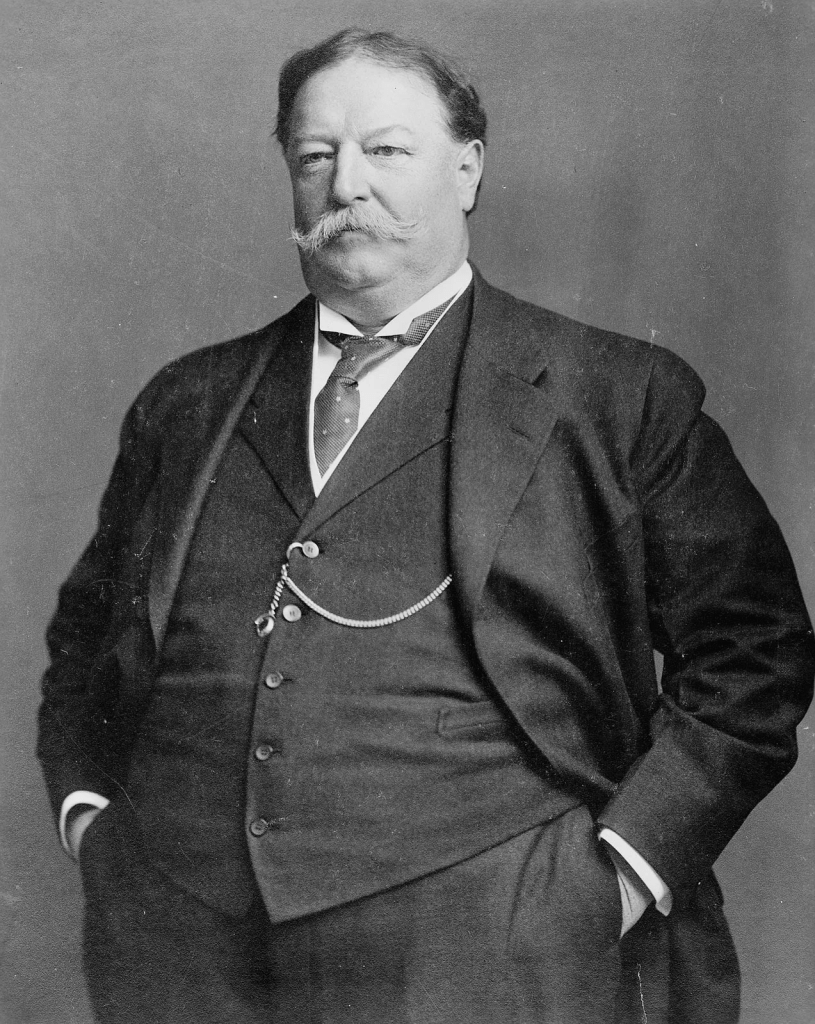
William Taft Administration
So, our good boy Teddy Roosevelt is up in 1908. He could run for a third term, but, eh, he’s done enough work. He’s ready to retire and hand the mantle to someone else. But who to hand the mantle to? Roosevelt decided to essentially exonerate Taft as his successor. Now, who was Taft? Taft was a lawyer who had risen up to become Roosevelt’s Secretary of War and his chief legal advisor. Roosevelt liked that Taft basically agreed with him on everything (even though, in real life, Taft probably just did that to get on his good side and get appointed as Supreme Court justice,) and so decided to give him the presidency.
Taft didn’t even know what to say and what political positions to take. He basically asked Roosevelt to write his speeches for him and tell him which policies he should support. Yet, despite the fact he was not prepared at all, Roosevelt was so damn popular that Taft was able to ride his old boss to victory in the 1908 presidential election, and it was a landslide, 321 – 162 electoral college votes.
Ok, so now our old boy Taft is now President. Now, what’s he supposed to do? Well, he basically just decides to continue whatever Roosevelt was doing. Two constitutional amendments passed during his presidency, the 16th and 17th ones. The 16th amendment basically allowed for the federal government to create an income tax; at this time, the only time the government had taxed someone’s income was under Abraham Lincoln, and it was only because the government REALLY needed money to pay their troops during the Civil War and they weren’t getting enough from tariffs. The other one, the 17th amendment, basically changed the voting process to elect Senators by saying that the people could directly choose their Senator instead of the state. The idea of letting the state choose was that the state would pick someone who was actually qualified for the job. However, as you can imagine, there was a lot of corruption and bribing, so they decided to give the choice to the people, although this arguably led to more corruption as Senate seats just became a contest of who spends more. Taft was an even more hardline progressive than Roosevelt on antitrust suits against big corporations, as in half the time Roosevelt had, Taft sued twice as many companies than him. However, there were areas of disagreement, primarily conservation and foreign policy. While Roosevelt was much more hawkish and wanted to fight out disagreements, Taft was more of a guy that wanted to talk to people and work things out peacefully, although that didn’t stop him from invading Central America. On conservation, Taft didn’t exactly think that Roosevelt had the authority to reserve millions of acres just by signing an executive order, instead believing that you needed Congress on board to do that. First, Taft fired two key Roosevelt-era conservation officials. Then, the administration freed up 3 million acres of land for private companies to use, basically undoing large swaths of Roosevelt’s conservation policy. Roosevelt was angry by these decisions, so angry that he would attempt to primary Taft, whom, again, he picked to be his successor; however, as it turns out, the GOP establishment didn’t want a radical populist like Teddy, they wanted a more stable and more moderate candidate like Taft.
Fuming against the GOP, Roosevelt and his fellow supporters formed their own party, the Bull Moose Party, and, as it turns out, Roosevelt was still pretty damn popular; Roosevelt defeated Taft by a margin of 5 points in the popular vote and won ten times as many electoral college votes as him. But, make no mistake, Roosevelt did not win the election; in fact, he didn’t even come close. Remember, the Democrats still exist. The Democrats put up a candidate whom nobody even knew was, and he only won 41% of the popular vote, but, since the GOP vote was split, the Democrats managed to somehow win. Without even really trying that hard, Woodrow Wilson won 435 electoral votes, winning every state except 8. This guy is, like, the second Democrat to be elected since the Civil War, and the first Southerner to be president since before the Civil War.
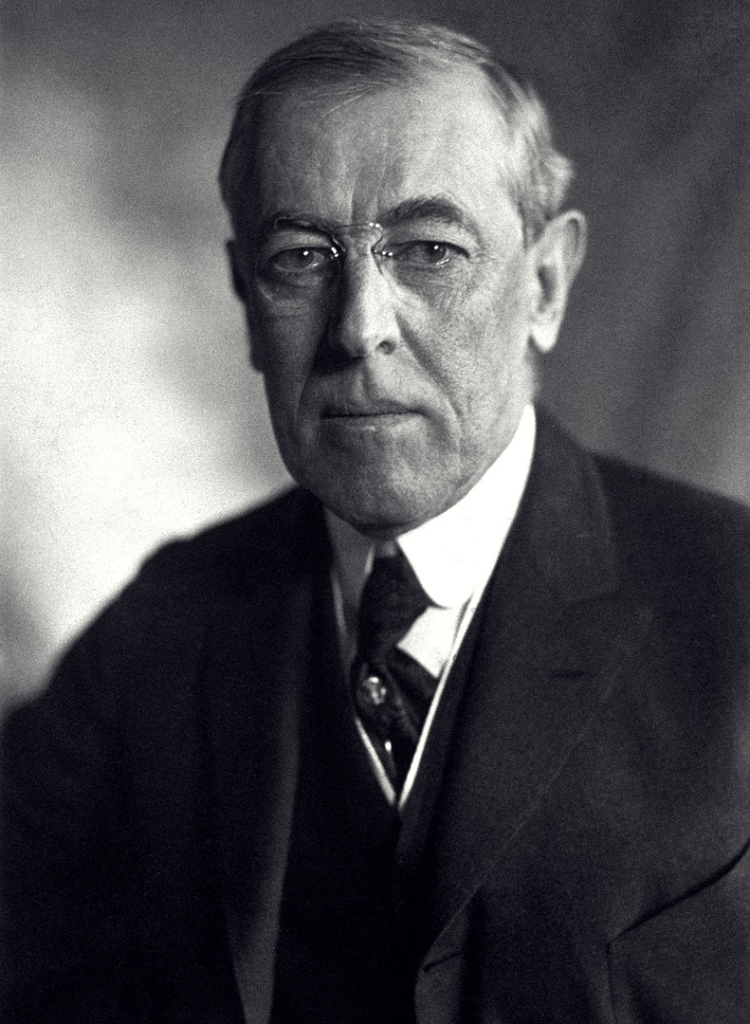
Woodrow Wilson Biography
Wilson was only 5 years old when the Civil War broke out in his home state of Virginia. Luckily for him, his family had moved him to Augusta, Georgia, far away from the forefront of the conflict, at least until General Sherman came along. As Sherman marched through the state, Augusta became a major hub for wounded Confederate soldiers to come there and get treatment, partly because of the Medical College of Georgia. Not only were there wounded soldiers, there were also refugees fleeing the Union army, as Sherman wasn’t necessarily the most kind general to women and children. Obviously, interacting with and seeing a bunch of mutilated, frightened people at five years old is going to probably have a lasting mental impact on you, although Wilson refused to talk about this period for the rest of his life.
However, from here on out, Wilson had a good life; even though he struggled with dyslexia, which left him unable to read until age 11, he was able to overcome his disability and become an avid reader, leading him to get accepted into Princeton University, where he would briefly enter law but ultimately decide to pursue history and political science as a career. Wilson loved studying, but he also was really good at being a leader, whether in his frat clubs, sports teams, and friend groups.
At 27, Wilson decided to get a doctorate at John Hopkins, which then let him become a well-respected professor at Princeton University, which then led him to become appointed as President of Princeton by the Board of Trustees, people who had valuable connections, who encouraged him to run for Governor of the incredibly corrupt state of New Jersey.
Wilson was a progressive Democrat and appealed to them as an intellectual member of the Ivy-League elite who could not get swayed by big corporations and the donor class. He was also, funnily enough, backed by big corporations and the donor class, who just really badly wanted a Democrat as Governor and who thought they could easily manipulate him due to his inexperience in politics. Wilson won the election, but he soon proved himself as someone who could not be swayed and manipulated. This shocked the business and donor classes. As Governor, Wilson passed and signed the Grand Bill, which broke up New Jersey’s corrupt political establishment, instituted new standardized regulations on schools to increase the quality of education, and enforced antitrust laws and workers protections vigorously. In just two years, Wilson had cleaned up a whole state; this earned him much positive publicity and national support. Wilson was both a Northern elitist progressive and a Southern traditionalist conservative at the same time; this meant he was basically the perfect Democratic candidate for the 1912 presidential election. Then, of course, he just so happened to be so lucky to be in the one election where the GOP vote was split, allowing him to win in a landslide.
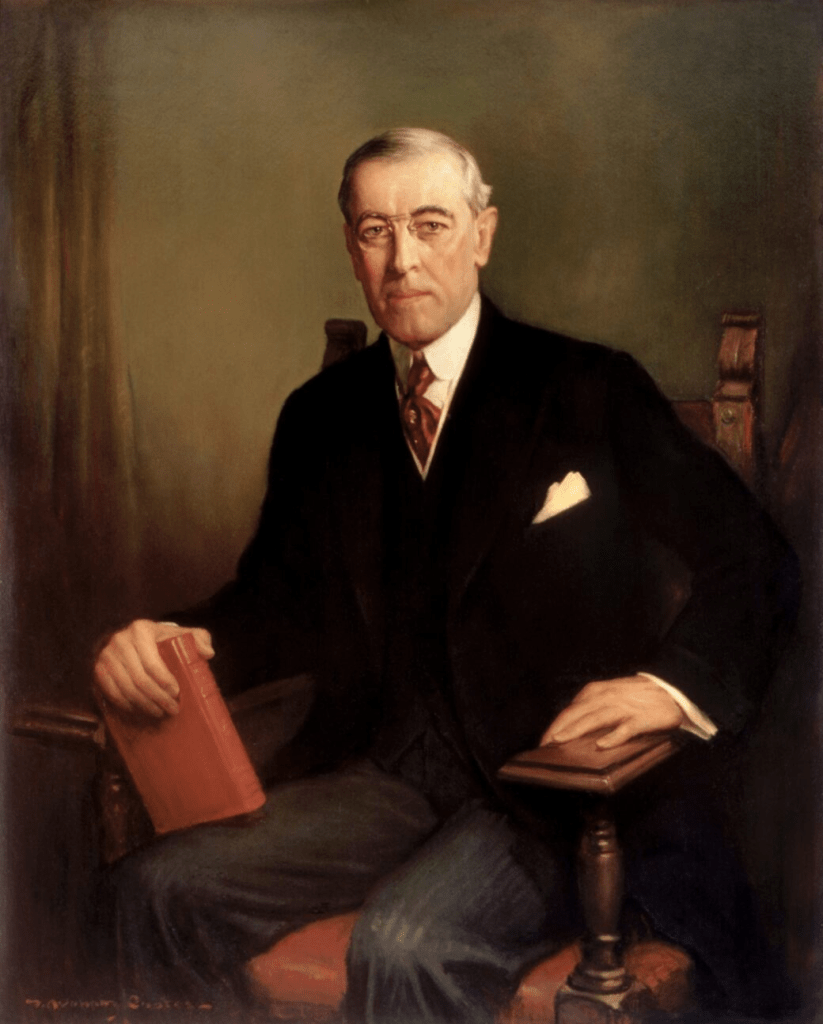
Woodrow Wilson Administration
Today, many consider Wilson to be one of the worst presidents in American history, yet those same “historians” consider Roosevelt one of America’s best presidents. However, Wilson and Roosevelt are so similar when it comes to policy, yet, historians put them on basically opposite ends of the chart. Teddy Roosevelt’s only criticism of Wilson was that his foreign policy was too liberal, showing he completely supported Wilson’s domestic agenda. Here is what Wilson did as President:
- Wilson signed into law the Organic Act, which established the National Park Service, and continued expanding conservation.
- He would create the Federal Trade Commission (FTC) as a better version of Roosevelt’s Bureau of Corporations, and he would make its’ goal to be to ensure all companies were complying with regulations.
- Wilson would institute an income tax on the top 3% of the population, and use that revenue to bring down tariffs by 14 points, which helped bring down costs for most Americans, and increase costs for the wealthiest Americans who could afford to pay it.
- The 19th Amendment was ratified, giving women the right to vote.
- The Sherman Anti-trust Act was expanded.
- Wilson signed into law the Adamson Act, which helped lay the foundation for the modern eight-hour workday.
- He began taking steps toward outlawing child labor.
- He even took Roosevelt’s position on hyphenated Americans, forcing German-Americans to assimilate during World War I.
As you can see, Wilson was able to get a lot done, signing legislation that achieved most of the progressive movement’s goals. So why don’t historians rank him higher? Well, there are some other more controversial things he did that muddied the water a bit.
Roosevelt believed that the United States was an equal power to the Great powers. Roosevelt supported militarism as a way to deter foreign powers and protect the homeland. He also believed that the United States had a duty to keep the hemisphere safe from foreign threats.
Meanwhile, Wilson was a pacifist idealist, seeking a future where there would be no more wars and different peoples would get different countries. He opposed Roosevelt’s colonial ambitions in Latin America, believing it was un-American to support taking over other countries. Wilson wanted to have better relations and just talk it out with Latin American countries. However, Mexico and Columbia basically refused to talk it out, while other countries descended into chaos, forcing Wilson to take action. Wilson would use his authority to escalate the Border War with Mexico, occupy the Dominican Republic and Haiti, and invade Honduras.
Wilson also delivered on the progressive promise to create a national bank, which Roosevelt set into motion. The economy in 1913 was not the economy in 1813. America was the largest and strongest economy in the world. There needed to be some sort of institution to control money and prevent monopolistic practices by the banks. Thus, the Federal Reserve was created. Some criticism of the Reserve exists, as it is both public-owned and private-owned, and is also pretty susceptible to corruption, as you need Presidential and Senate approval to appoint a new member onto the Bank.
Under Wilson, Prohibition was also passed. The anti-alcohol temperance movement had existed for decades, and it was steadily gaining traction. Ethnically, Anglo and Protestant folks were very supportive of Prohibition, while Catholic Irish and German folks weren’t. But, World War I led to intense persecution and xenophobia against the German American population, and, as a result, America soon became anti-alcohol as well, as the largest pro-alcohol group in the country now basically just lost all their national influence. Congress passed the 18th Amendment, which allowed for the banning of alcohol, and then the Volstead Act, which actually banned alcohol. Wilson himself did not actually support Prohibition, and vetoed the Volstead Act, yet his veto was overridden by Congress. The Volstead Act set much higher standards for what alcohol would be banned, meaning even less intoxicating substances like beer were banned. However, the federal government basically refused to enforce their own law, while state governments didn’t enforce the law because it was a federal law, and it wasn’t their responsibility.
Now, let’s talk about World War I. For its first 3 years, the Great War was a European conflict, and America was basically the place that manufactured all of the goods that came to the Allies. This was because the warring powers don’t have the time or resources to produce materials themselves, so they basically relied on America for it. This would cause a boom in America’s manufacturing and agricultural sector. Beyond this, European nations also took out a bunch of loans they couldn’t pay back, leaving them in debt to America for many years. Yet, as the war dragged on year after year, the European powers wanted another country to join in on one side or the other to bring the conflict to an end. As Germany continued its attacks on American shipping and even requested Mexico to invade the United States, Wilson considered this a violation of American neutrality and successfully convinced Congress to declare war. Wilson ordered an expansion of the American army, and by the end of 1917, American troops were beginning to arrive in Europe on the Western Front. Just a year later, Germany officially surrendered.
Wilson saw the war as two bad sides going to war for something the other guy had. He honestly did not care that much when Germany was defeated; he wanted to leave his mark on the world through the peace negotiations and bring about everlasting peace. To do this, borders would be redrawn to represent cultures and nations, free trade would be the law of the sea, all countries would demilitarize, and all countries across the world would come together in one association where they could work their differences out together. However, it didn’t exactly go Wilson’s way. The Allies refused to accept Wilson’s vision and were instead hellbent on revenge against Germany, Republicans sweeped Congress in the 1918 midterms and refused to accept Wilson’s vision, and Wilson couldn’t articulate his vision effectively, since his health soon came in rapid decline, so much so he was barely able to do the jobs of a president.
As his second term came to an end, his ambitions for the world were left incomplete and likely never to happen. He wanted to run for a third term, but since he was so unhealthy, he did not get the nomination.
The Democrats picked someone who was a very capable progressive, yet due to the bad state of the economy, which was in a recession, voters elected compromise Republican candidate Warren G. Harding to the presidency in 1920 in a mass rejection of globalist policies and a desire to just go back to normal. It was a landslide, and it marked the beginning of a new decade of American politics.
 History Explained
Leave a comment