Theodore Roosevelt had sent into stone a new era in American politics, an age of big government, moralistic policy, and foreign interventionism. Roosevelt and his successors worked to eliminate corruption and inefficiency to create a world power that could compete with other countries. Progressivism reached a peak under the Woodrow Wilson administration due to Prohibition, new progressive anti-banking measures, and America’s entry into World War I. By this point, the public was exhausted with progressivism, and turned to more conservative laissez-faire presidents like Harding and Coolidge, who brought America back to normalcy and made America a prosperous and wealthy nation of great patriotism and pride. Americans once again embraced idealism and progressivism after an 8-year break, but this time they wanted to do it with the respect and consent of the big business class. Then, Herbert Hoover came along.
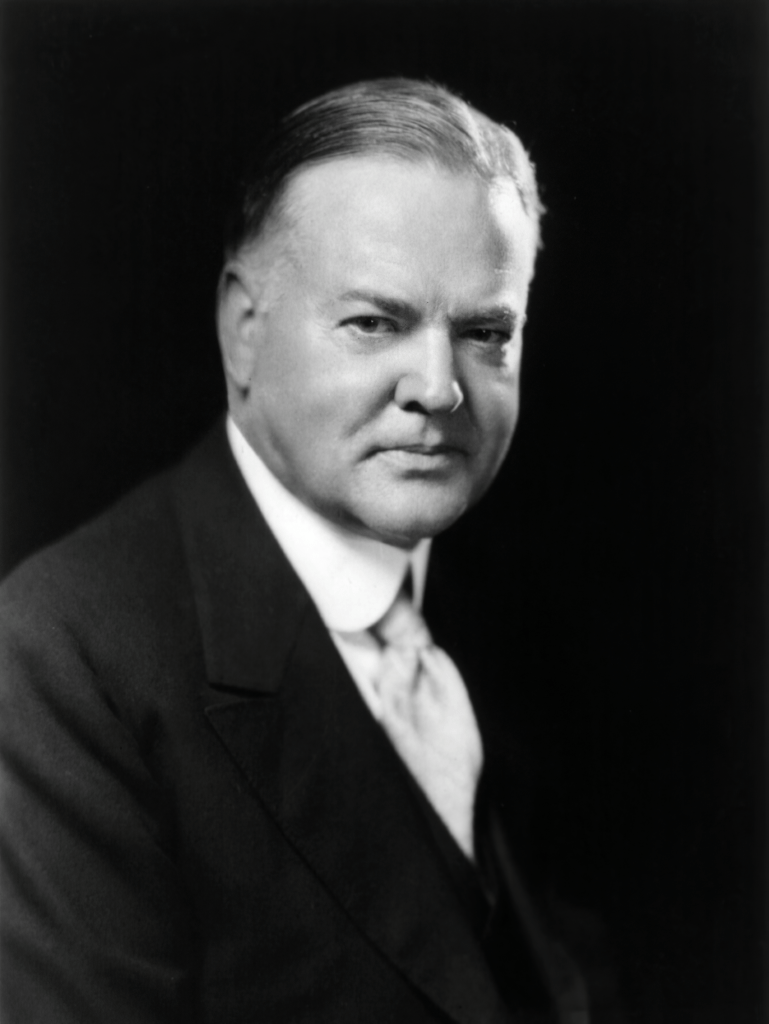
Herbert Hoover Administration
Hoover had an impressive and well-experienced background: he was a civil engineer-turned businessman and philanthropist, and he worked in the Wilson, Harding, and Coolidge administrations, trying to push more progressive policies. Hoover was seen by many as the new Roosevelt: someone who was a progressive and pushed for progressive reforms but did so without being too radical; he was a moderate who, as a businessman himself, respected the role big business played in society and sought simply to tame its worst aspects. However, unfortunately for Hoover, he would barely have any time to implement his new vision, as in 1929, the stock market crashed, and the Great Depression began.
Due to the conservative laissez-faire policies of the Harding and Coolidge administrations and the general financial prosperity, the stock market was booming in the 1920s, and more and more people were investing in it, but many economists warned the stock market was volatile, and, at any moment, if the stock market crashed, you should prepare to divest your savings and sell everything, although some, more smarter economists warned against that too, but those people were in the minority. After a fraudulent account in the London Stock Exchange was suspended, stocks in New York took a significant dip. And, so, most stockholders, following the advice of those not-so smart economists, decided to divest and sell everything, and so, the stock market just kept going down and down. However, it also turns out the banks had used the savings they had gotten from their customers to invest that in the stock market as well, so when the stock market crashed, they had no money, and they couldn’t reimburse any of their clients. As a result, banks across the country closed down as they had literally no way of running.
At this point, Hoover realized that he couldn’t pursue his original agenda, and so took all the resources he was going to use to enact his agenda and put them into trying to stop the depression, increasing the role of government in the economy significantly as a result. However, even despite this time of emergency, he still tried to balance the role of business and government, which literally led to the worst results; he should have either done nothing and let business run its usual course, or intervened a lot and propped up the economy, but instead, he just chose the worst possible option. With the 1932 election coming soon, the Republicans and Hoover were extremely unpopular as the economy was in complete freefall, and the Democrats promised intensive government action with a business-government balance (which is exactly what Hoover promised to do.) The Democrats were literally campaigning on the same policies Hoover supported, but were essentially just saying that they would execute them better. The main way they got away from this was that he misrepresented Hoover’s views as someone who didn’t want the government to intervene in the economy at all, which he was not, and Hoover wasn’t able to respond because he was scared, yes scared, of public speaking.
The progressivism promised and implemented by Wilson and Roosevelt was not enough for the day. The purpose of the government was to grow every day, day by day. If you stopped growing the government for a year, or for even one single second, you would not only halt the march of civilization, you would go backwards. That was the philosophy and campaign promise of Franklin Delano Roosevelt, the Democrat’s candidate for the 1932 presidential election.
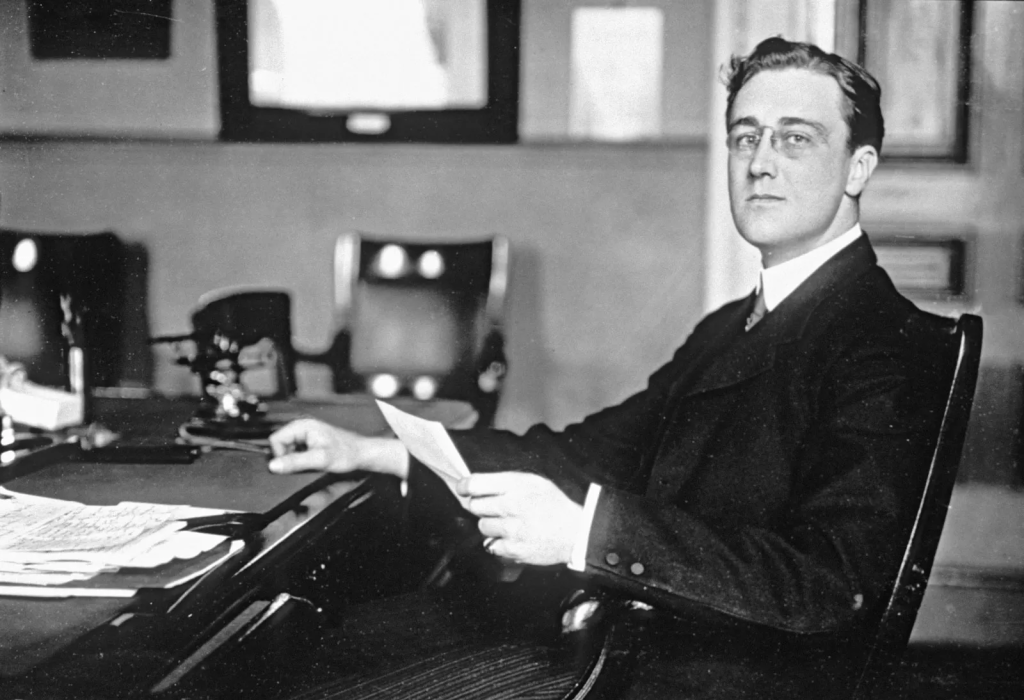
FDR Biography
Roosevelt was born in Hyde Park, New York, in 1882. His wealthy family gave him private education, traveled abroad with him, and basically prepared him to become someone who was going to be very influential. His mom, Sarah, was Roosevelt’s major figure in his life, staying with him until 1941, when she passed away. Sarah cared about Franklin, but he also was very protective of him. Sarah opposed Franklin’s marriage to Theodore Roosevelt’s niece, Eleanor. After their marriage, she purchased a house right next to Franklin’s and Eleanor’s house to keep tabs on the two, and she played a very active role in raising her grandchildren.
While Roosevelt’s father was caring, he wasn’t able to be with him for a long time, due to work and health issues, but Franklin did find another role model, Reverend Endicott Peabody, an Episcopal priest, cousin-in-law to Theodore Roosevelt, and Headmaster of the Grotton Boarding School. Peabody taught FDR that he had a public duty to care for those in need, words that Franklin would remember for the rest of his life. Franklin also really liked Thomas Jefferson, whom he regarded as an aristocratic elitist intellectual who cared for the people and established what would become the foundations for the modern Democratic party. Franklin disregarded the southern agrarian view of Jefferson held by most historians at the time, which Jefferson wanted to be seen as but actually was not.
As Franklin’s cousin Theodore became President, Franklin went to Harvard Law. Franklin loved and largely agreed with his cousin’s ideas of progressivism and entered politics with a sense of moral duty to help the public. In 1910, Franklin would win an election to the New York Senate in a Republican district. As Senator, Franklin focused on battling the corrupt political establishment of Tammany Hall in Manhattan, successfully blocking one of their appointees and negotiating a compromise with the establishment. Franklin also supported agricultural and labor reform bills, earning him a reputation as a progressive reformer and someone who was essentially doing what his cousin had done.
When the 1912 election came about, Franklin backed not his cousin but Democrat Woodrow Wilson. He would be rewarded by Wilson by being appointed Assistant Secretary of the Navy, although since the real Secretary of the Navy wasn’t very good at his job, Franklin basically was the Secretary of the Navy at the time. He played an important role and learned a lot about military organization but also how to negotiate with labor, due to negotiations between Franklin and the members of the Navy’s own labor union.
Wilson would easily win re-election on the promise of keeping America out of war, but as soon as he won his second term, Franklin told Wilson to begin preparing for American entry into World War I, which he viewed as inevitable but Wilson, at the time, opposed. After the sinking of the Lusitania, Roosevelt presided over a naval buildup and was largely concentrated on World War I for the rest of Wilson’s term.
With Wilson’s presidency coming to an end, Franklin would now be moving on to the next step in his political career. Now, he would look at Theodore and what he did. After serving as Assistant Secretary of the Navy, Theodore became Governor of New York and McKinley’s running mate before becoming President. However, his run for Governor ended in disaster, as he lost the nomination to Tammany Hall’s preferred establishment appointee. So, Roosevelt decided to make a run for Vice President, and he hoped he would be on the ticket with friend and member of the Wilson administration Herbert Hoover. However, by this point, while Hoover was a progressive, he hadn’t declared himself a Democrat or Republican yet, before ultimately declaring himself a Republican. This disappointed Roosevelt, who was a Democrat, but he was still selected as the Democrat running mate alongside capable progressive James M. Cox, but with Americans tired of progressivism, Harding and Coolidge defeated the Cox-Roosevelt ticket in a landslide. Roosevelt saw his election loss as a bump in the road, and thought he would pick himself back up next election and maybe even make a run for the Governorship or presidency, but then, everything changed.
While he was on vacation, Roosevelt became paralyzed from the waist down. Although, at the time, it was diagnosed as polio, some modern scientists suggest it might be a result of a neurological disorder, the result of his earlier contraction of the Spanish flu. At this point, Sarah told Franklin to sit back and relax for the rest of his life at Hyde Park, but both Franklin and Eleanor said no. Franklin would try his best to adapt to polio and build close relationships with top progressives, including New York Governor Alf Smith, who then asked Roosevelt to be the Democrat nominee for Governor in 1928 so that he could be the Democrat nominee for President. Although Landon would end up losing the 1928 election to Herbert Hoover, Franklin would narrowly win with Landon’s support.
In charge of New York during the Great Depression, Roosevelt governed based on three pillars: (1): government aid, (2): public works, and (3): rooting out corruption, with Roosevelt firing a bunch of people Smith had appointed since Smith was more friendly with Tammany Hall. This made Smith really mad, leading to a decade-long rivalry between the two, until right before Smith’s death in 1944.
FDR would sign the Power Authority Act, authorizing the construction of a large hydroelectric dam alongside the St. Lawrence River. Roosevelt also sought to eliminate Tammany Hall, because he knew that if it was still standing, he would have to play by their rules to win elections. To do this, FDR established the Hoffstetter Committee, the goal of which was to find corruption in New York City’s corrupt legal system. The corruption uncovered was so great that the establishment tried to murder and disappear witnesses to prevent it from getting out. With this, Roosevelt was able to jail many of Tammany Hall’s most corrupt officials and replace them with anti-corruption progressive crusaders, essentially ending their decades-long iron grip over New York politics.
However, the biggest thing FDR did as Governor was focusing on trying to tackle the Great Depression. Roosevelt would establish the Temporary Relief Administration to build new public works and create more jobs. Roosevelt would also work towards banking reform and unemployment compensation as well. Roosevelt did so well as Governor that he became famous, and he was the Democrat nominee for the 1932 presidential election. Roosevelt would defeat Hoover in a landslide and assume the office of President, with many suggesting that Roosevelt should get emergency dictatorial powers to do whatever he wants without congressional approval so that he could bring a quicker end to the Depression.
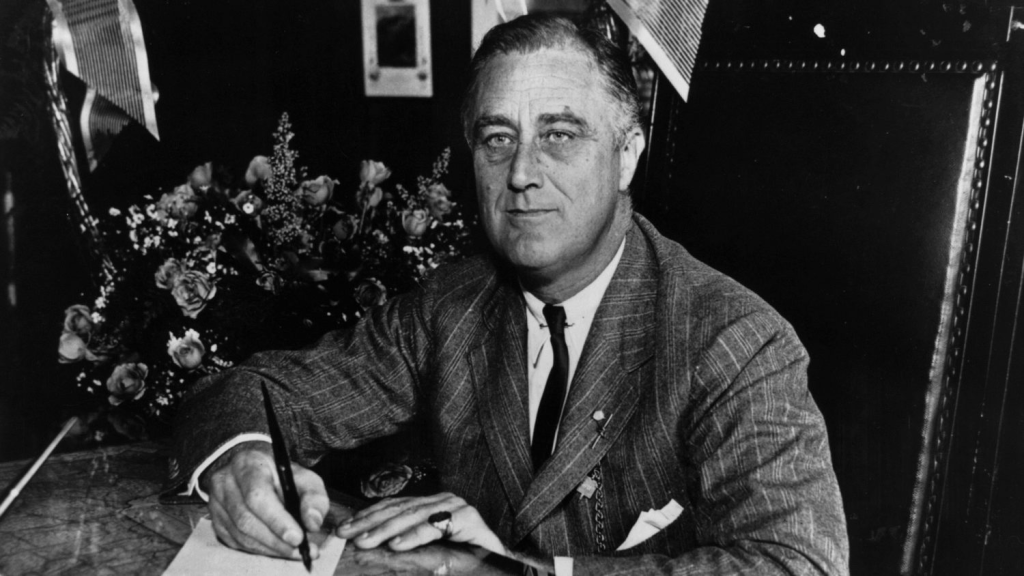
A New Deal
FDR wanted to take the success he had in New York and transplant that to the rest of the country, but, truthfully, there wasn’t a bigger plan than that. The policies that Roosevelt had instituted in New York were less about ending the Depression and finding its’ root cause and more about alleviating its symptoms to make public life better. FDR wanted to do experiments with different options to find the best plan. Franklin met with the outgoing president Herbert Hoover, where he refused Hoover’s offer to work together to solve the depression, with FDR asserting that Hoover could’ve solved the depression but he didn’t. Roosevelt and Hoover agreed upon a lot actually, yet Roosevelt basically refused to support the same policies that Hoover did; here is a list of what Roosevelt did.
- Immediately upon taking office, Roosevelt would call for a bank holiday, where the federal government would inspect banks across the country and determine whether they could stand the burden; if they could operate, they would be allowed to reopen, but if they couldn’t, then they would either close or be given assistance by the government.
- Roosevelt also scaled back the intensely high tariffs of the past few decades to give Americans an extra option of buying cheaper foreign products and allowing for American goods to be sold in other countries where those goods were not available.
- Roosevelt also supported public works projects, since it hit two birds with one stone; it reduced unemployment and fixed America’s crumbling infrastructure. The most famous of these was the CCC (Civilian Conservation Corps,) which created 250,000 jobs and built 13,000 miles of trail, planted 2 billion trees, and upgraded 250,000 miles of roads.
- Roosevelt would sign the Agricultural Adjustment Act and establish the Agricultural Adjustment Administration, (which Hoover had proposed,) to provide relief to farmers who had way too many products on their hands that they couldn’t sell and thus would decrease prices.
- The National Recovery Administration was basically a copy of what Hoover wanted, which was a partnership between government, business, and labor for the common good; the agency did succeed in its goals, which were to improve working conditions, reduce competition, and stabilize prices. However, it would be considered unconstitutional by the Supreme Court just two years later and struck down.
- Roosevelt would also establish the Good Neighbor policy, which would establish friendlier relations between the U.S. and Latin America, a repudiation of Wilson and Roosevelt’s more interventionist policy, and basically a more successful version of Taft’s foreign policy.
- Congress would overturn Prohibition through the passage of the 21st Amendment.
- And, of course, Roosevelt would build a monument to his hero, Thomas Jefferson, as expected.
In doing all these radical actions, Roosevelt and the New Deal would make a bunch of enemies, split into three camps, people who thought Roosevelt was overstepping his executive authority, people who opposed Roosevelt’s policies and thought they were bad for the economy because they hindered business, and those who simply had a grudge against Roosevelt, like Smith and Hoover. All throughout this, Roosevelt had basically become pro-labor and labeled the New Deal’s opposition pro-business and conservative, which basically ignored Roosevelt’s campaign promise to pursue a balance between labor and business. Essentially, the term progressive now meant supporting the New Deal, and if you didn’t, well, even if you were considered progressive 10 years ago, you weren’t progressive anymore. This was essentially very similar to what happened with Jefferson and Jackson; basically, Jefferson and Roosevelt had created the ideologies of Democratic-Republicanism and progressivism, and Jackson and FDR had taken it to its logical next step.
There was also a conservative backlash to FDR’s policies, through the American Liberty League and later the Conservative Coalition, led by Robert A. Taft, the son of President William Howard Taft, while the New Dealers continued to become more and more liberal. This foreshadows the modern party dynamic, where Republicans are considered conservative and Democrats are considered liberal, and this is likely where that dynamic began. However, there were still divides in the GOP. There were the conservatives, who were mostly in the Midwest, the liberals, who were mostly in New England, and the progressives, who were mostly in the Far West. The conservatives, led by Taft, opposed foreign interventionism, were socially conservative, and generally opposed New Deal economics. The liberals, led by Thomas E. Dewey, were willing to compromise on New Deal economics, and were supportive of foreign interventionism, free trade, and socially liberal values. The Progressives, led by former President Hoover, supported New Deal economics, were socially moderate, and were kind of supportive of foreign interventionism, although they opposed free trade. The Democrats were also split, between the conservatives in the South and the progressives in the North, and as Roosevelt was increasingly alienating the conservatives, he needed to hone in on certain demographics if he wanted to keep Democrat control of Congress in the midterms and win reelection.
FDR was a strong supporter of labor unions, which got him increased support in the cities, especially from many ethnic and religious minorities who were often working in low-skill labor jobs. He won a lot of support among Catholics, who were mostly either Irish, Italian, or Polish, and Eastern European Jews, as well as support from urban Blacks who had fled north during the Great Migration in fear of Southern persecution. Roosevelt would also mostly keep the southern vote, since Southerners were staunchly Democratic just by name, and they liked Roosevelt’s pro-agriculture policies after the Dust Bowl affected their crops. However, many Southerners questioned Roosevelt over his appeal to minorities, his far-reaching social programs, and the fact that most of Roosevelt’s public works weren’t in the South, although this was likely because the South had a much better employment state than other areas of the country did. Whatever the case, you see a lot of conservative Southern Democrats defecting to the Republicans, who are increasingly embracing them, which really foreshadows the future, where Republicans become the party for all conservatives, and the Democrats become the party for all liberals and progressives.
This strategy would pay off, as Roosevelt’s Democrat party would keep control of both houses of Congress and even expand their majorities. Roosevelt, seeing that the public had now given him a wide mandate, implemented what he called the Second New Deal which was even more wide-reaching, radical, and economically interventionist than the first:
- Roosevelt raised taxes, establishing a 79% income tax on those making above $5 million a year, a 75% income tax on those making above $1 million, and a 27% tax on corporation’s profits that were not paid out in dividends.
- He also established the Works Progress Administration, which was charged with employing as many workers as possible for new infrastructure projects. The WPA employed 8.5 million workers and built around 650,000 miles of highways and roads, and around 125,000 new public buildings, as well as 5,900 athletic fields and playgrounds, 770 swimming pools, 1,700 parks, and 8,300 recreation buildings. The program was a huge success, and only served to increase his popularity among urban voters, where it appears his new center of popularity is. This trend of the Democrats being extremely popular in the cities is still true to this day.
- With elderly folks struggling across the country due to the depression, Roosevelt established Social Security, a system where if you pay your FICA tax, you get benefits when you’re older, essentially a social safety net that funds itself.
- Roosevelt also continued to deliver for labor unions by signing into law the Wagner Act, which guaranteed the right to collective bargaining, prohibited discrimination against union members, and established the National Labor Relations Board (NLRB.)
With the Second New Deal and consequently Roosevelt as popular as ever, Roosevelt and Democrats rode their popularity to victory. Roosevelt won 515 electoral votes and 60% of the popular vote, while congressional Democrats expanded their majority to encompass more than 3/4ths of both the House and the Senate. It appeared Roosevelt was going to continue to enact more radical policies and expand the role of government even more.
But, as the economy slipped into yet another recession, and conservatives became more organized, the stage was set for a massive conservative backlash.
 History Explained
Leave a comment