FDR’s Second Term
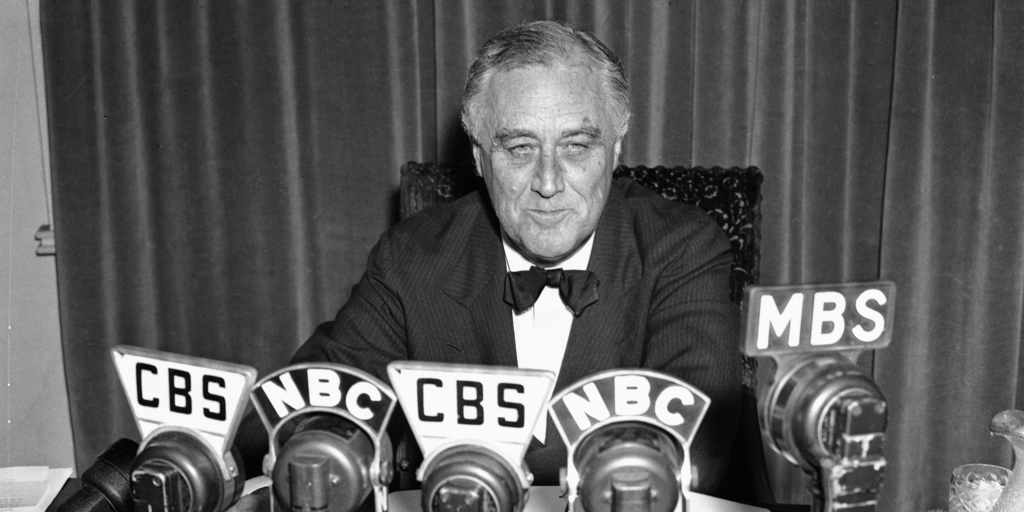
Although his first term was highly legislatively successful, his second term was not. Roosevelt’s first legislative priority of his second term was to pack the Supreme Court by expanding the number of justices on it. This was because the Supreme Court had become notorious for being incredibly conservative and striking down several major pieces of New Deal legislation it deemed unconstitutional. The legislation Roosevelt proposed would have added 6 more justices onto the Supreme Court, which would have all been appointed by him, and would have been New Dealers. However, both Democrats and Republicans opposed the legislation, recognizing it as an attempt to force the President’s will onto the Supreme Court.
There was also an economic recession from 1937 to 1938. This led to many Americans publicly questioning whether the New Deal was actually working. Many thought that the recession was the cause of the New Deal hampering business. In response, Roosevelt decided to abandon his fiscally conservative policies in favor of more spending, and he got Congress to agree to around $4 billion in new spending to help prop up the economy.
However, by this point, Americans were now very skeptical of the New Deal. There was now a clear divide in America – not between Democrats and Republicans, but between New Dealers and conservatives. Conservative Southern Democrats teamed up with conservative Republicans to form the Conservative Coalition, led by Taft, which won control of Congress in the 1938 midterm elections and stalled the passage of any new major economic legislation for the rest of Roosevelt’s presidency.
World War II
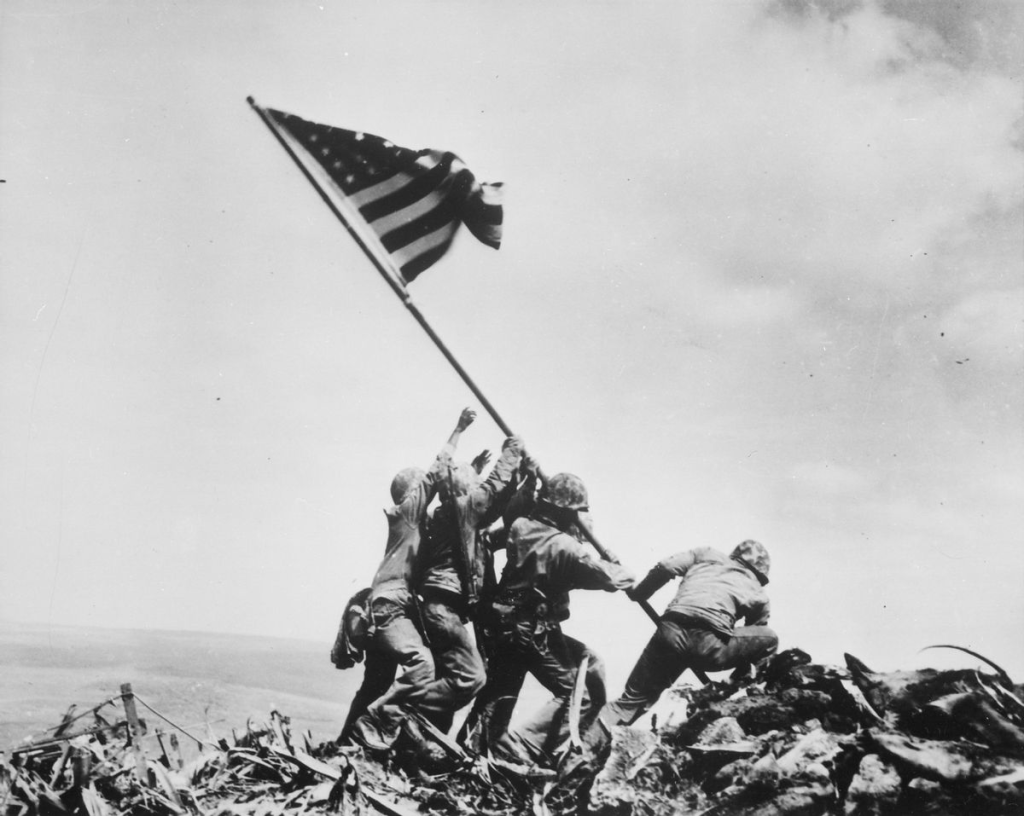
The economy would slowly recover from the recession, but it wasn’t until the start of World War II that the economy really started to boom again and the main new thing about the New Deal era started to reveal itself, as there had always been a tension between business and government, and ever since the Republican era, the power of business was decreasing, and the power and size of government and the regulatory state was growing. The true main new thing about this era was that the New Dealers tried to make America a global superpower with influence across the world, something that Theodore Roosevelt tried to do but failed, something which Wilson was forced to do, and something that the Harding, Coolidge, and Hoover administrations ignored, as they focused more on domestic policy. Meanwhile the world was changing: the invasion of Ethiopia, the invasion of Manchuria, the annexation of Austria, and the Spanish Civil War, all were happening around this same time; Roosevelt really wanted to do something about it but he couldn’t because of the Neutrality Acts, which wanted to prevent the U.S. from being dragged into another world war.
After World War II broke out in Europe, Roosevelt decided to run for an unprecedented third term, hoping that he could use the war as a way to rally the public behind him, win back Congress, and pass the remaining parts of the New Deal agenda. Roosevelt was rapidly losing his allies, as he was breaking with a long-held tradition dating back to Washington, and he was growing increasingly ideologically radical and unwilling to compromise. The Republicans had a new strategy: pick liberal candidates that were similar to FDR but were slightly more moderate. They picked Wendell Wilkie, who, like Roosevelt, was also a New Yorker. Wilkie supported the New Deal (or at least a more moderate version of it) and even wanted to give aid to the Allies, but he firmly did not want America directly involved in the war. Roosevelt, knowing intervention was unpopular, claimed he also did not want to get America directly involved (even though he secretly wished.) Roosevelt won by a wide margin, although a margin that was closer than his past performances, and he was sworn in for a third term, the first and only president to have served more than two terms.
Day by day, Roosevelt worked to weaken neutrality laws, and day by day, the U.S. began giving more and more aid to the Allies, in order to become what Roosevelt called an “arsenal of democracy.” Roosevelt also was a supporter of the Preparedness movement during World War I, which advocated for the U.S. to mobilize its military in favor of the Allies, yet Wilson had refused to; this time, Roosevelt was the boss, and he would do what he wanted to do the first time around. Roosevelt would also build up an ideological basis for getting America involved in the war with his “Four Freedoms” speech, where he emphasized that the U.S. should actively be involved in spreading democracy and freedom to every corner of the planet. Roosevelt would also institute the policy of “Lend Lease,” which would essentially allow us to give aid to other countries without them having to pay us back, as long as it, at least officially, served America’s interest.
The Conservative Coalition began to collapse, with the Northern Midwestern conservatives generally not wanting to intervene, and the Southern historically hawkish conservatives generally wanting to intervene, and the latter gradually pressured the former into supporting interventionism. With the now-full support of Congress, the U.S. began providing tens of billions of dollars worth of aid to Britain, China, and the Soviet Union, essentially bringing the United States into the war in every way except boots on the ground, virtually guaranteeing that the Axis would retaliate, and then the U.S. would be able to convince the public to get involved in the war; this was Roosevelt’s grand master plan. Roosevelt met with British Prime Minister Winston Churchill and negotiated the Atlantic Charter, which was a plan for what the world would look like if the U.S. joined the war and the Allies won. Under this charter, America and Britain would become the leaders of the world. Basically, the U.S. and Britain would not take any territory, any changes in borders would have to get the people’s consent, there would be global free trade, every country would disarm, and every land would be allowed to choose what to do with itself, although Churchill thought “every land” meant those under Axis control. However, Roosevelt and the New Dealers emphasized self-determination for every land, which would mean decolonization and the end of trade monopolies held by colonial empires, with Roosevelt subtly pressuring Britain throughout the war on Churchill’s suppression of the Indian independence movement.
The U.S. stopped doing business with the Axis powers, and this meant that Japan, which had no natural resources and was reliant on trade with America to fund its conquest of Asia, now no longer had any resources to keep the conflict going. There were some negotiations, but the U.S. demanded Japan stop their conquests, which Japan refused, so no deal was made. However, there was a lot of oil and natural resources in the East Indies, but in order to capture the East Indies, you needed to capture the American fleet in the Philippines and the British base at Singapore, but in order to do that, you needed to neutralize the U.S. Pacific Fleet, which was at Pearl Harbor, Hawaii. And so, the Japanese attacked Pearl Harbor, but, fortunately, U.S. aircraft carriers, the most valuable part of the Pacific Fleet, were not at the base at the time and thus were not destroyed. While Japan was able to sink a few ships and kill around 2,000 U.S. troops, they were not able to neutralize the Pacific Fleet; however, the U.S. now had just cause to declare war. A few days later, Germany declared war on the U.S. Roosevelt got his wish. America was now at war, and America would win.
However, by the time the 1944 election rolled around, the war had not ended yet, and Roosevelt’s health was worsening by the day. However, he wanted to give the U.S. consistent leadership during the war. He would run for an even more unprecedented fourth term, and he was once again face another liberal Republican from New York, Thomas E. Dewey. However, just 82 days after he was sworn into his fourth term, Roosevelt would tragically pass away, and he would be succeeded by his Vice President, Harry Truman.
Many people saw Truman as this clueless farm boy that knew nothing about politics, but he was determined to prove himself. A month into his term, Hitler would commit suicide, and Germany would surrender, and now the full might of America was on Japan. We could invade Japan and lose millions of lives, or we could use another, more expedient option. Since 1941, Roosevelt had authorized a project to develop nuclear weapons, the Manhattan Project. In July 1945, an atomic bomb would officially be tested. Just a month later, it would be used, first against Hiroshima and next against Nagasaki. With the Soviet Union announcing their invasion of Japan, Japan would decide to surrender days later, faced with the prospect of an impending Soviet invasion and the destruction of more Japanese cities. The peace treaty was signed a month later; the war was over.
Harry S. Truman Administration
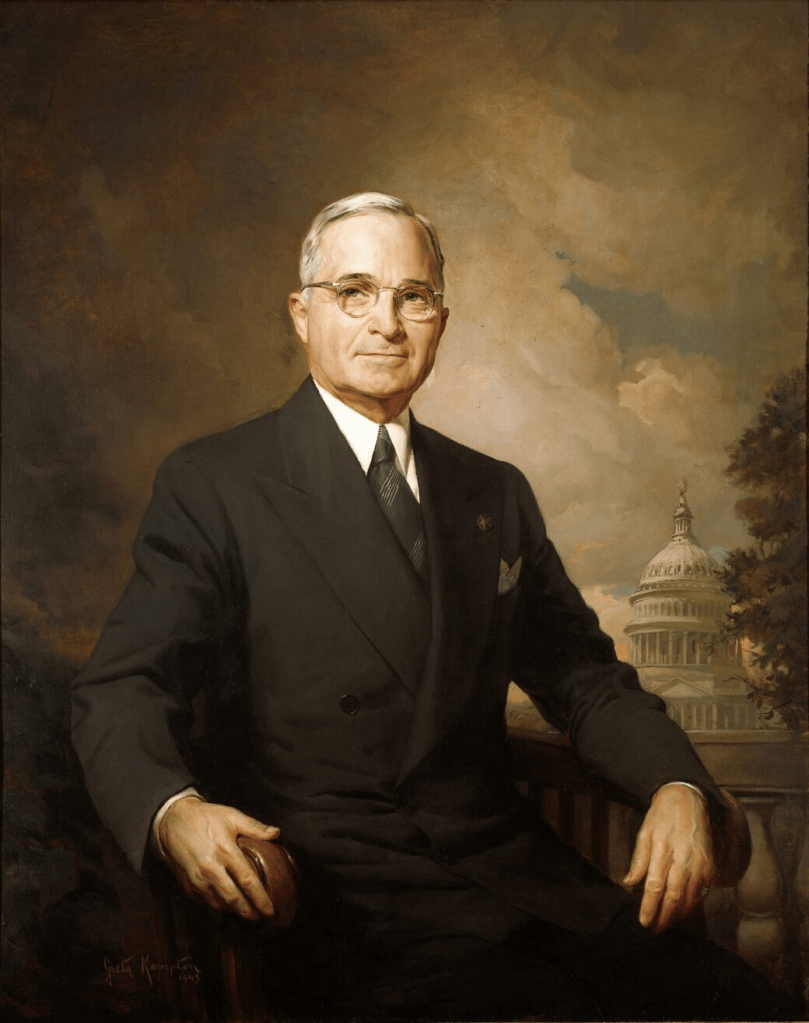
The war economy had lifted the U.S. out of the depression, but Truman had a lot of work he wanted to do. Truman had neither the charisma of FDR nor the crises that kept the country together during the Roosevelt administration, leading to him rapidly losing support, with Republicans taking Congress in the midterm elections. Truman was not prepared to handle the reconstruction of Europe, did not know how to manage the United Nations, and was left to deal with the Soviet Union and the emerging Cold War. To deal with these problems, Truman decided to take the advice of people who were more experienced and who knew more about foreign policy, such as Dean Acheson and George Marshall.
Truman started off by reorganizing the Office of Strategic Services, which was established by Roosevelt during the war, into the National Intelligence Authority and Central Intelligence Group to give him intelligence on foreign policy. Together, these two agencies would combine to form the Central Intelligence Agency (CIA,) which came to be increasingly active during the Cold War.
Domestically, Truman wanted to take the New Deal and transform it into the Fair Deal, which he wanted to be tailored to a thriving economy instead of a struggling economy. The Fair Deal continued New Deal emphasis on infrastructure development and public works, but there was a new aspect -civil rights. Truman signed an executive order desegregating the military, established a commission to investigate civil rights matters, and gave a speech to Congress demanding they take action to bring about racial equality in the country. Southern Democrats, outraged by the federal government trying to enforce civil rights upon them, decided to leave the New Deal coalition and form their own party, the Dixiecrats. In the 1948 election, four Southern states backed Dixiecrat Strom Thurmond. However, despite this split, Truman narrowly defeated liberal Republican Thomas E. Dewey in a massive upset.
Many Americans were very scared that communist Soviet spies had infiltrated the U.S. In response, Truman issued an executive order allowing the FBI to investigate employees if they might pose a threat to national security. However, Truman didn’t take the communist threat seriously, despite the fact that there was evidence that he could’ve seen that showed it.
However, the Cold War and foreign policy would dominate Truman’s second term. The Marshall Plan would be implemented, giving aid to countries in Europe so that they can rebuild, Truman would decide to recognize Israel despite Marshall warning him not to, and NATO would be established as a defensive alliance of Western European powers, which would later be expanded to include Greece and Turkey. However, there would also be the outbreak of the Korean War, which was made worse by a failure of Truman’s first term, where he was unable to set up a coalition government in China, leading to a communist takeover of the country. The Korean War would cost millions of lives, with the war ending almost exactly where they began, leading the U.S. to choose to act more covertly through the CIA.
The 22nd Amendment was ratified, ensuring that there would be a two-term limit for all Presidents, with the exception of the current President, Harry Truman. However, Truman was unable to win the nomination since he was so unpopular, leaving the Democrats without any good candidate. The conservatives of the GOP, led by Taft, were giddy, thinking this would finally be their chance to take the reins of power. However, the liberals would quickly step in and support Dwight D. Eisenhower as their candidate, who would narrowly beat out Taft for the nomination and would then win the presidency.
 History Explained
Leave a comment