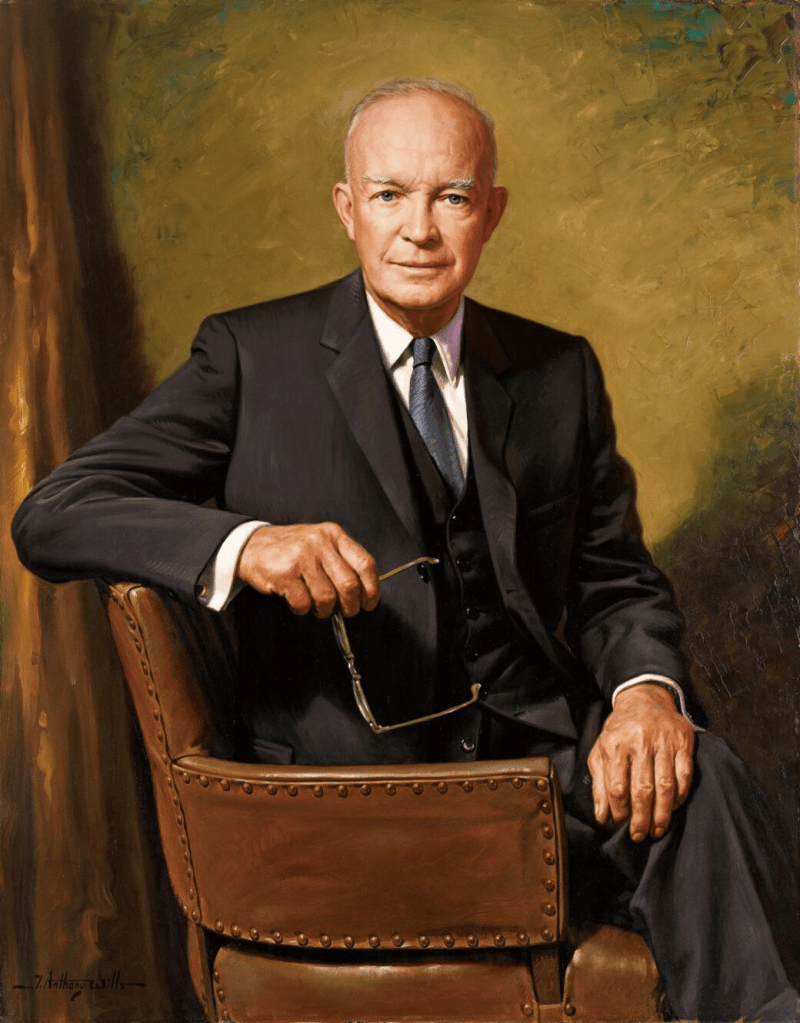
Dwight D. Eisenhower Administration
Eisenhower wasn’t your typical liberal Republican or conservative Republican; rather, his ideology was referred to by commentators as “modern Republicanism,” but in reality, he wasn’t a conservative at all. He was a staunch supporter of the New Deal and even expanded it through his Interstate Highway System and his broadening of Social Security to around 10 million more Americans, while also continuing the Truman-era focus on civil rights, using the military to enforce school desegregation in Little Rock, Arkansas and expanding protections of African-Americans’ voting rights through the Civil Rights Act of 1957; Eisenhower framed civil rights as a national security issue, as the Soviets could use segregation as propaganda to hurt America’s global reputation.
Foreign policy wise, Eisenhower continued expanding America’s global influence as a superpower, approving a CIA-backed coup in Iran, ending the war in Korea, intervening in the Suez Crisis to pressure France, Britain, and Israel to withdraw from Egypt, pushing for decolonization, and helping France in their war with Vietnam. However, when a communist revolution broke out in Cuba, Eisenhower just sold a few weapons to the Batista government, and then eventually stopped selling those weapons. This inaction led to the rise of the communist government in Cuba, and then Eisenhower finally authorized the CIA to begin planning for a regime change invasion of Cuba to remove Fidel Castro. In yet another geopolitical mistake, Eisenhower also announced the Eisenhower Doctrine, where he said that the U.S. would protect Middle Eastern countries from “international communism,” which really just meant that the U.S. wanted to suppress the popular Arab nationalist movement, which promoted left-leaning economic policies.
Despite the fact that Eisenhower was a Republican, he basically just continued New Deal/Fair Deal-era policy, which received a lot of criticism from conservatives at the time in his party, like the-then Junior Senator from Arizona Barry Goldwater. In both parties, opposition to the New Deal was sidelined, and they didn’t get any actual representation at all. While Republican conservatives were effectively made silent, the Southern anti-New Deal Baptists decided to leave the Democratic party and form the Dixiecrats in the 1960 presidential election.
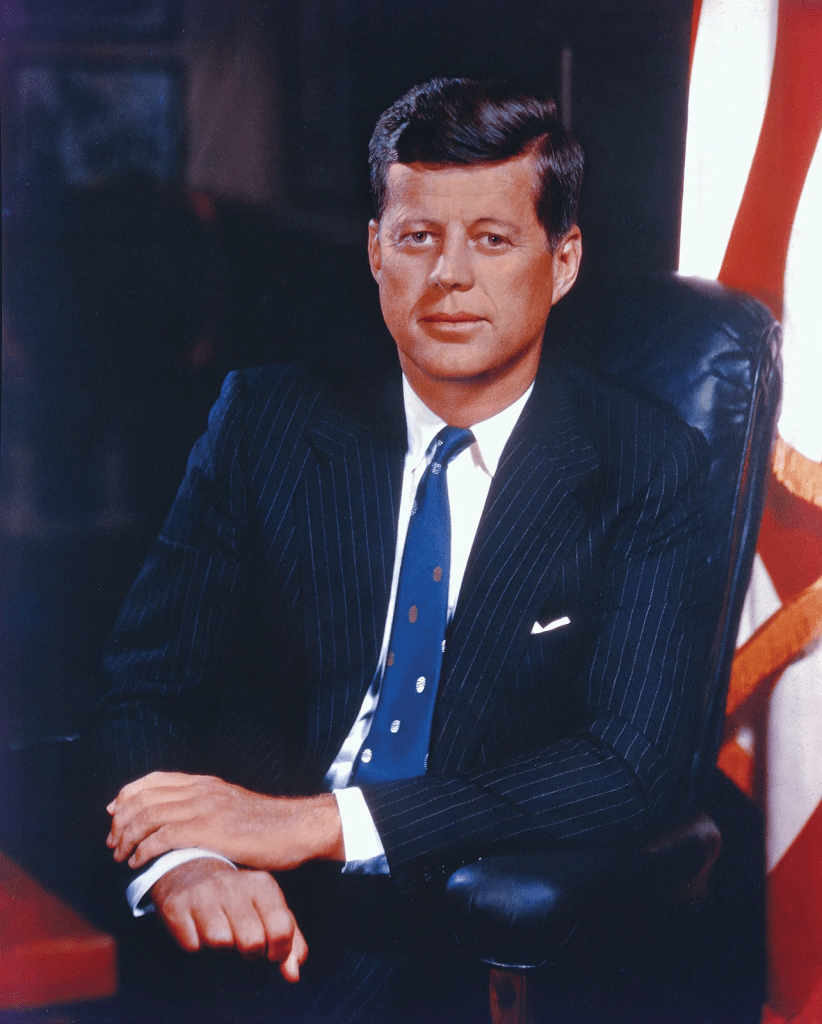
John F. Kennedy Administration
In 1960, the Republicans would put up Eisenhower’s Vice President, Richard Nixon, while the Democrats would put up a young, charismatic Senator from Massachusetts John F. Kennedy. The election was incredibly close, with the popular vote being less than ½ of a percentage point, and several states going one way or the other by about 1 percent, but Kennedy ultimately came out on top. Despite accusations of tampering and fraud, Nixon ultimately chose not to challenge the election results, and Kennedy was sworn in as the first Catholic President and the youngest man that was ever elected to the office of the presidency. The historic nature of his presidency and his tremendous charisma and popular appeal largely makes up Kennedy’s legacy.
Early on, people saw Kennedy as more of a celebrity than an actual political leader. On economic policy, Kennedy didn’t really care much about fiscal or antitrust policy; instead, he wanted to work with business, proposing a Keynesian-style tax cut, foreshadowing the future popularity of neoliberal economic policies like tax cuts, deregulation, and free trade. At his VP Lyndon Baines Johnson’s recommendation, Kennedy expanded America’s space program, NASA, the National Aeronautics and Space Administration, which had begun under Eisenhower. He expanded the Apollo program’s mission to include putting a man on the Moon by the end of the decade. Kennedy was actually kind of skeptical of the space program, but Johnson would keep pushing it through, and during Kennedy’s administration, Johnson made the program effectively his pet project.
Similarly to Truman and Eisenhower, Kennedy’s biggest focus on the home front was civil rights. Being an Irish Catholic himself, Kennedy had felt the effects of discrimination when he was younger, but he couldn’t have imagined what it must have felt like for the more recent Italian immigrants who were just moving their way up the ladder of American life, unlike him, who belonged to a more fortunate family. However, the rise of Italian immigration and other third-waivers also contributed to the rise of organized crime, including in the cities, and this crime began to bleed into American politics. Kennedy’s heart also went out to African Americans, who had long been victims of discrimination in the Deep South. The third immigration wave, consisting of mostly Irish, Italians, Poles, and Jews, who had come to America in the late 1800s and early 1900s, and this group had now become very activist and calling for equality in the United States, including support of civil rights.
Kennedy really defined his presidency not on his domestic policy, but rather his foreign policy. Following the Bay of Pigs invasion, which failed on its objective of removing Fidel Castro from power, the Soviets placed nuclear missiles in Cuba, and after U-2 spy planes photographed these missiles, many Americans were scared that nuclear war was coming. Kennedy masterfully was able to defuse the crisis, negotiating a deal with Soviet Premier Nikita Khrushchev wherein the U.S. would promise not to invade Cuba and would withdraw missiles from Turkey and Italy in exchange for Russia withdrawing their missiles from Cuba; during this crisis, his approval rating rose to 77%, and Kennedy demonstrated to America that despite many people prejudicing him because of his youth, inexperience, or ethnicity, he was able to effectively steer the country through crisis.
In the Americas, Kennedy expanded upon the Good Neighbor doctrine by creating the Alliance for Progress, seeking to build closer ties with Latin American countries. However, at the same time, the CIA pursued covert operations against left-wing leaders in Latin America, such as in Guyana, Brazil, and Chile, as well as in the Middle East, where Kennedy strengthened U.S. relations with Israel, likely to shore up his support among Jewish-Americans, who overwhelmingly voted for him. Kennedy also escalated America’s presence in Vietnam, increasing the amount of troops from Eisenhower’s 900 advisers to around 16,000 personnel by November 1963, and South Vietnam Ambassador Henry Cabot Lodge Jr. also covertly worked to back a coup that resulted in the assasination of South Vietnamese President Ngo Dinh Diem.
On November 22, 1963, John F. Kennedy was assassinated while driving in a presidential motorcade through Dallas, Texas; the shooter, Lee Harvey Oswald, a crazy man who had sympathized with the Soviet Union, was caught hours later, but he was murdered the next day by strip club owner Jack Ruby. The unusual circumstances surrounding Kennedy’s death, Oswald’s suspicious murder, and a number of inconsistencies, as well as the increasing autonomy of the CIA, the rise of organized crime, the secrecy of the Cold War, and the power-hungriness of Kennedy’s Vice President Lyndon Johnson all have led many Americans to speculate that either there may have been a second shooter, or that Oswald didn’t even kill Kennedy, and he was a patsy for the CIA, the mafia, Johnson, or the Soviets (take your pick.) In March 2025, President Donald Trump announced the release of around 80,000 pages of files relating to the assassination, which reveal that the US government had been warned about Oswald, and that Ruby had ties to organized crime in the country. However Kennedy died, he was dead, and his Vice President, Lyndon Baines Johnson, would now take the reins of power.
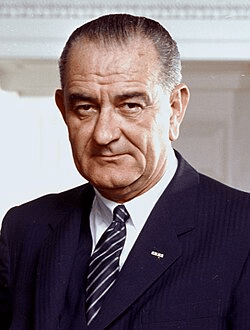
Lyndon B. Johnson Administration
Johnson was a friend of FDR and deeply admired his New Deal policy. Johnson did not have principles; rather, he was extremely power hungry and conniving, and these qualities helped him rise the ranks in American politics to become the Senate Majority Leader and eventually, Kennedy’s running mate and Vice President. When he was Vice President, Johnson did everything he could to increase the power of his office, and this made Kennedy and his aides very distrustful of Johnson.
As President, Johnson established the Warren Commission to investigate the Kennedy assasination, which unanimously concluded that Oswald acted alone, and sought to finish enacting Kennedy’s legislative agenda. He got those tax cuts Kennedy wanted passed, and, continuing Kennedy’s crusade for civil rights, he signed into law the Civil Rights Act of 1964, a landmark bill which outlawed discrimination and criminalized racial segregation. However, beyond just doing what Kennedy wanted, Johnson sought to make his own mark on history by creating his own program called the War on Poverty, seeking to “not only relieve the symptoms of poverty but to cure it – and above all, to prevent,” by creating new jobs, expanding access to education, and giving aid to people struggling to afford goods by creating the Food Stamp program.
After completing the term left by Kennedy, Johnson sought to win an election to a full term, and he went up against the Republican candidate Senator Barry Goldwater. He was a business conservative and a social liberal, much like the northeastern conservatives. Goldwater, ethnically Jewish himself, was a strong supporter of civil rights, but, just like the southern conservatives, he was opposed to big government and was a supporter of states’ rights, which caused him to oppose the Civil Rights Act of 1964 on grounds of constitutionality and states’ rights. Goldwater’s stance on civil rights caused the entire Deep South to vote for him, the first time in history that all the Southern states voted Republican. However, literally every other region opposed Goldwater: Northeastern conservatives opposed his stance on civil rights, midwestern conservatives didn’t like that he wouldn’t use government power to advance conservative policies, and progressive New Dealers literally had nothing in common with Goldwater at all. Thus, Johnson would win re-election in a landslide, winning by the largest share of the popular vote since 1820.
Johnson escalated American involvement in Vietnam to the point that America was effectively involved in war after the Gulf of Tonkin Incident, which we now know was basically made up by the Defense Department to get America involved in the Vietnam War. American involvement in the war would continue until 1973, and the war would cause American morale and pride in their country to decrease significantly.
Johnson’s civil rights legislation did not calm racial tensions, but in fact inflamed. For the next few years, several race riots occurred across several major cities over several years that were caused by tensions between people who thought Johnson’s civil rights didn’t go far enough and people who thought that the Civil Rights Act went too far. To figure out the cause of these riots, Johnson established the Kerner Commission, which said that the reason these riots were happening was that the whites were actually too racist, and they needed to do more to promote equality. This finding occurred despite the fact that 90% of the riots occurred in the North and West, not in the South, showing that the cities that made the most progress on racial integration were the ones that had the riots. Despite these riots, which might have suggested that the progress of integration was going too fast, Johnson instead chose to double down on civil rights, signing the Voting Rights Act and the Civil Rights Act of 1968 into law, and he also appointed several African Americans to key positions.
Johnson also signed into law the Hart-Cellar Act, which abolished the previous National Origins Formula, which wanted to keep the immigrants of the same demographics that Americans were, and instead opened immigration to all countries, causing a sharp increase in both legal and illegal immigration over the coming years. Johnson also increased federal funding for education in an effort to promote greater access to education for the poor, yet despite this, scores on standardized tests dropped significantly after 1965. Johnson also signed the Social Security Amendments of 1965, which created Medicare, a system of health insurance for the elderly, and Medicaid, a system of health insurance for the disadvantaged, and he created the Model Cities Program to experiment with ways to combat poverty, although this just led to people who worked on these programs using the money from their paychecks to escape the poor areas for higher-income neighborhoods; overall, the combined efforts of Johnson’s anti-poverty programs were that the poverty rate 50 years after the initiation of the program was largely the same, the spending on the programs led to a significant increase in federal spending, and thus the national debt, and the program institutionalized incentives for single motherhood, leading the Black single motherhood rate to rise from under 20% in 1960 to around 70% today.
By 1968, it was clear that Johnson’s programs had failed: American boys were dying in an unpopular and useless war, inflation was out of control, the deficit more than doubled, and Johnson’s health was coming into question. As a result, Johnson’s approval dropped to the mid-30s, and the New Deal coalition completely collapsed. Johnson, facing an almost certain re-election loss, suspended his campaign. Meanwhile, the Republicans were slightly better, running former Vice President Richard Nixon. The New Deal coalition that had once swept FDR to power in 1932 and a successive series of pro-New Deal Democrats and Republicans ever since, was now dead. The country wanted change, but in order for that change to come, they would have to wait a bit, as a tumultuous road lay ahead.
 History Explained
Leave a comment