Tag: thomas-jefferson

  • Madison & Monroe

    Now, although Jefferson was done with his 8 years in office, his party, the Democratic-Republicans would continue to be the party in power at this time, and the next three presidents that followed Jefferson were all Democratic-Republican: James Madison, James Monroe, and John Quincy Adams, continuing Jefferson’s agenda and policies. Madison and Monroe served two terms, while Adams barely even won his first one.

    James Madison Administration

    Madison had co-founded the Democratic-Republican Party with Jefferson and continued Jefferson’s policies, essentially 16 years of the same administration. However, after the War of 1812 ended, Madison realized that a strong central government, economy, and military was actually necessary to the nation’s security and desperately tried to promote Federalist policies in the last few years of his presidency, but he ultimately failed in doing so.

    However, this was not a big surprise to anyone. Madison used to be a Federalist, co-authoring the Federalist Papers with John Jay and Alexander Hamilton, and was much closer to Washington than Jefferson was. This foreshadowed what would occur later down the line.
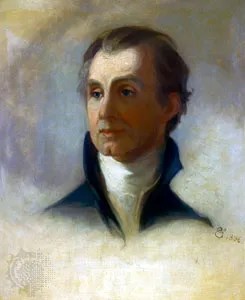
    James Monroe Biography

    Monroe was, in my opinion, a remarkable president. Yes, he’s part of Jefferson’s Democratic-Republican Era, but I think he should be discussed more than he is for his unique character and contributions to the Democratic-Republican party. 

    Monroe was born on April 28, 1758, in New York. His family had decent money, owning land and enslaved slaves, showing that they had a moderate level of wealth for the time. However, Monroe had to do a lot of laborious work throughout his early life.

    He spent 4 times as long working on his family farm than he did on his school. Then, his parents both died when he was just 16 years old. He dropped out of school and focused on farming full-time to support himself and his younger siblings. Remember, at 16 years old, Jefferson went off to college so that he could party with his peer students and his professors, so this was a massive difference in what both were doing.

    Monroe’s uncle felt sorry for him, and he wanted his nephew to succeed in life, so he lent him a hand and helped him go to college and get proper education. However, when the Revolutionary War broke out, Monroe decided to drop out of college to fight for his country.

    Unfortunately, Monroe would be struck by a musket ball in the shoulder that severed his artery. His life would be saved by a doctor who stopped the bleeding by pressing a finger into his wound. He would recover from his injuries and return to combat, serving during the Battle of Brandywine(September 1777) and the Battle of Germantown (October 1777) and was promoted to Captain for his bravery. After the war ended, Monroe got a new tutor. Guess who….

    If you guessed Thomas Jefferson, you’re right! Monroe was literally the representation for the perfect self-sufficient agrarian American that Jefferson idealized. He had a modest and disciplined lifestyle, was part of the independent yeoman farmer class Jefferson championed, and was known for his humble and unpretentious character. These were all qualities that the Democratic-Republicans admired in a leader.

    Monroe was smart, shown by his military strategy, diplomatic acumen, political vision, and legal & intellectual contributions. He was strong, famous for his perfect posture and tall height. He was independent and self-sufficient. His military service and belief in Democratic-Republican ideology proved he was loyal and dedicated. He was the perfect Democratic-Republican politician, and to Jefferson, the perfect man to carry on his legacy.

    However, there was a very big difference between Jefferson and Monroe. Jefferson was rich, famous, and powerful. He had never suffered from want, because he got everything he wanted. He spent days wanting to have a simpler life. On the other hand, Monroe was a labourer in his early life. He knew how horrible and boring it would be for him to do manual labor his whole life.

    Now, for a regular man, doing manual labor and farm work could’ve been enough. Had Monroe been a regular man, he would’ve gotten nowhere. He would’ve been stuck toiling the fields for the rest of his life. History would not have remembered him.

    But Monroe was not a regular man. He was not fine with farming. He was not fine with being forgotten. He wanted to do something, go somewhere, be someone. But that path to being the top would be rocky.

    Jefferson and Monroe would work together to advance Democratic-Republican ideals. Jefferson’s wealth and status launched Monroe, a common agrarian man, into politics. They were great friends and close neighbors. Monroe once wrote to Jefferson in a letter, “I feel that whatever I am at present in the opinion of others or whatever I may be in future has greatly arisen from your friendship.” Quite the dynamic duo, right?

    Monroe, however, faced several early political missteps before solidifying his legacy. He initially opposed the U.S. Constitution, which made him unpopular, lost a Congressional bid to the House of Representatives to James Madison, and strained U.S.-France relations during his time as Minister to France, which forced President Washington to recall him. Despite this, he stood by Jefferson’s side through it all, and did what Washington did, watched and learned, playing a pivotal role in negotiating the Louisiana Purchase, which doubled the size of the United States.
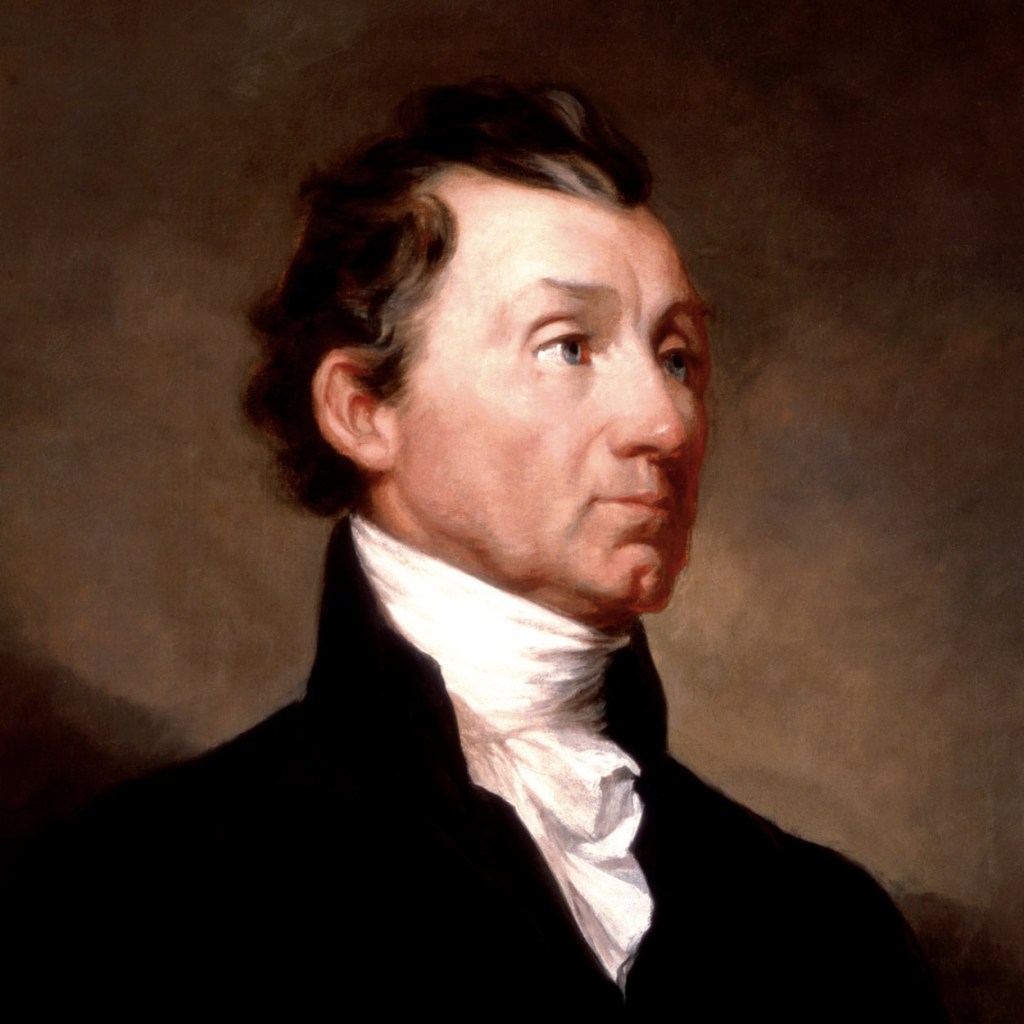
    James Monroe Administration

    Now, Monroe was very pragmatic in his policies as President, incorporating some policies from the Federalist Party into his own. This was partly because he recognized that the Federalists were no longer a prominent political party, and they would dissolve under his watch, essentially turning America into a one-party state.

    For example, Monroe implemented major infrastructure projects during his presidency. He expanded the Cumberland Road all the way into Ohio, which became the first major highway built by the federal government. In the wake of the War of 1812, he also emphasized national defense, authorizing projects such as military roads and fortifications along the Atlantic coast. He also encouraged the construction of the Erie Canal and began looking for more canal and waterway opportunities connecting major cities.

    Monroe’s shift towards infrastructure development, protective tariffs, and even a National Bank, all major Federalist policies, all led many prominent Federalists to either join the Democratic-Republican party or agree to cooperate with them in what became known as the “Era of Good Feelings.” Some of these Federalists include John Quincy Adams, Richard Rush, Harrison Gray Otis, Rufus King, and Daniel Webster. The loss of these figures ultimately drove the Federalist Party to complete extinction. 

    Now, Monroe did this on purpose. The Democratic-Republicans had dominated national politics for around 20 years by this point. He had an idealistic vision of Democratic-Republicans and Federalists working side-by-side to advance an agenda the whole country agreed with without political parties even existing. Of course, he only advocated for this because the country was pretty much completely entrenched in the ideology of the Democratic-Republicans by this point. And while it initially seemed Monroe’s vision would come true, it all soon came crashing down.

    In foreign policy, President Monroe issued the now-famous Monroe Doctrine, essentially warning European powers of future colonization attempts. This made clear that the US would support anti-imperial and republican movements across the Western Hemisphere. This would set the stage for American imperial dominance of the Western Hemisphere in the early 1900s that still exists today.

    However, just as it seemed that everything was going to be fine, and Monroe’s vision for the future of the nation was coming true, everything completely changed in the next election, shocking everyone.

  • Andrew Jackson

    The Election of 1824

    In the election of 1824, instead of one Democratic-Republican run and win unanimously, four Democratic-Republicans ran, with each representing a different regional string of Democratic-Republicanism. John Quincy Adams, a former Federalist, would represent the Northeast; William H. Crawford would represent the mid and southeastern states, the party’s establishment; Henry Clay would represent the Western states; and General Andrew Jackson would represent the southeastern states. 

    The results of the election popular vote saw Andrew Jackson take a heavy lead with 41%, John Quincy Adams take second place with 31%, Henry Clay taking third place at 13%, and William H. Crawford coming last at 11%, and the results of the electoral map have Jackson taking a lead with 99 votes and Adams coming second with 84. However, Jackson did not get a majority of the electoral votes as was required to be president, so Congress decided the election, and with Crawford’s health very steadily and rapidly declining by this point, they picked Adams, a member of this establishment, rather than Jackson the populist outsider; however, this would not happen next election, with Jackson carrying 178 electoral votes in a landslide, compared to Adam’s 83, and with a majority of the votes, Jackson was sworn in as President.

    Andrew Jackson Biography

    Andrew Jackson’s life is the saddest and most inspiring of all of the presidents. His family was not well-established in the colonies, but had immigrated from the Irish province of Ulster. They settled in the frontier area of the border of the two Carolinas (it’s not clear which state he was born in) and were pretty poor. Jackson’s tragedies started before he was even born, with his father dying before he could ever meet him. The lack of a father made Jackson aggressive and bitter, and he would be like that for the rest of his life. 

    Jackson’s mother encouraged her three sons to fight against the British when the Revolution broke out. Andrew’s brother Hugh would join the militia but would die of having a heartstroke during the battle. Andrew and his other brother Robert would also join as couriers but would also be captured, where Andrew’s face was slashed by a British officer after refusing to work. The British would eventually release the two due to the incessant pleading of Andrew’s mother and Andrew’s age, but the horrors wouldn’t stop there.

    Now released from captivity, Andrew, Robert, and their mom would have to walk 40 miles home, with Andrew and Robert both suffering from smallpox. Robert would die of smallpox a few days later, and Andrew’s mother would die of cholera a few months later. At just 14 years old, everyone in Andrew’s immediate family was dead, and his other relatives didn’t want to take care of him because of his aforementioned aggressive and bitter character.

    It seemed that Andrew was going to become a homeless boy in the street, begging for money for the rest of his life, but he didn’t let that defeat him. He became a saddlemaker while finishing up school. He’d go to an apprentice school for law and become a very famous and respected lawyer. He would become a justice in Tennessee’s Supreme Court, help found the city of Memphis, and command the state’s militia; he was also a very wealthy and successful businessman.

    Jackson would become famous nationwide after defeating the Red Stick Indians after they massacred 500 civilians during the War of 1812, and his next major task would be to defend New Orleans from invasion by the British. He placed it under martial law, organized new regiments for Blacks and Native Americans, and collaborated with French privateers (a code word for pirates) to help defend the city from the mighty British military. It would end in a stalemate, though because the last battle of it was an American victory, many Americans remember the whole war as won.

    Jackson would invade and conquer Spanish Florida for the U.S., become Florida’s first governor, and run for president in 1824. He saw the Democratic-Republican party as having grown way too corrupt and representing the ideas of the elite. He blamed Monroe for allowing such corruption to foster within the party, destroying the original values of Democratic-Republicanism Jefferson had outlined. According to Jackson, the party was filled with corrupt elitists and nepotists, with anyone who challenged the elite’s rule being quickly outcasted. The government was full of politicians who cared about themselves, and Jackson promised to change that. 

    One of Jackson’s key pillars was his democratization. All free white men should be able to vote, the state should have independence, but the country must be first, the President should have more authority than Congress, which was the figurehead of the elite, and all members of all three branches of government should be elected based on popular vote. The individual must be totally loyal to his party, and the state must be totally loyal to the federal government. Loyalty in general was another one of Jackson’s pillars. It often decided how he felt about a certain group or individual, and whether they should deserve rights or not. Another pillar was principles. Everyone must do everything by their principles, and for Jackson, this principle was to put the country first at all times. Anyone who did not abide by this principle was fired and even threatened with death.

    In the election of 1824, Jackson was extremely popular and won more votes, both through popular vote and the electoral college. However, because there were so many candidates running at once, Jackson could not get a majority, and thus the election went to Congress, who, because Jackson was not part of the corrupt political establishment, voted for Adams instead. Essentially, the corrupt and elitist members of Congress threw away the man whom the people had voted for so that they could still cling on to their power, exactly the kind of corruption that Jackson had warned about his whole campaign. Jackson was so mad that he said, “If I live, I’ll bring that scoundrel [Henry Clay, Speaker of the House] to the block [hang him.]”

    He returned home very mad, but he was nominated to run for President almost right after in October 1825. The people would stand behind Jackson, doing everything they can to tarnish the reputation of the corrupt party and call out every mistake of the illegitimate rule of John Quincy Adams. Of course, the pro-Democratic Republican media would fight back, accusing Jackson of murder and cannibalism. For the murder, he did duel with an expert marksman after he insulted his wife. Jackson was shot first, but then he shot the marksman twice, killing him. The second shot was because his gun jammed the first time, which was illegal at the time, but dueling in general was illegal at the time in Tennessee; Jackson never went to court for this. The cannibalism thing was just completely made up; there’s no evidence to prove it at all. The media then crossed a line which should not have been crossed, attacking Jackson’s wife, which would give her tremendous stress and later kill her, something which made Jackson very, very, very, (1 million times later), very, mad and bloodthirsty for revenge.

    Andrew Jackson Administration

    Jackson overcame these media accusations and won the highest voter turnout up to that point, double the turnout of Thomas Jefferson all those years ago. He was truly the “People’s President.” After his inauguration, he hosted a huge party with all of his supporters to show to the elite how popular he was, but the next day, he got straight into action.

    A huge investigation was launched to find any politicians that committed any crimes like embezzlement, defrauding the nation, and taking bribes. Jackson was unable to find Clay of any wrongdoing, but, ultimately, thousands of documents were recovered, several laws were passed to prevent this corruption from happening again, and 900 officials were fired and replaced with patriots who actually believed in America. Historians today claim that this was a “spoils system”, where he replaced qualified officials with political loyalists. However, in reality, the officials he fired were actually very corrupt, and while they were experienced, this doesn’t change the fact that they broke the law and 100% deserved to be let go.

    Jackson attempted to implement total democratization, electing the president solely through the popular vote and electing Supreme Court justices through popular vote. Had this been passed, this would’ve destroyed the system of checks and balances that America was founded upon and allowed for tyranny by majority at the possible expense of a minority, but thankfully for America this wasn’t implemented.

    Jackson also saw the National Bank as a den of the elite and political corruption, while being blind to the fact that it improved trade and confidence, allowed for efficient tax collection and repayment, stimulated investment and internal improvement, curbed speculation and inflation, and provided financial stability in downturns (Remember that last one.) Instead of reforming it, Jackson decided to eliminate it completely, leading to unregulated expansion of credit, high inflation, and dangerous economic speculation. On the other hand, the dissolution of the Bank, the rooting out of government corruption, and the decrease in government spending allowed Jackson to pay off every dollar of the National Debt, something that no other president has ever been able to do. 

    Even though Jackson had rooted out corruption and disloyalty in the federal government, there was still disloyalty at the state level, when South Carolina unconstitutionally bypassed a tariff that they believed harmed their economy and threatened to secede. With Jackson’s own vice president advocating for South Carolina instead of him, Jackson essentially pressured him to resign, as to him, the country was above everything else. Jackson allowed states to pretty much do whatever they wanted to, but he wanted them to cooperate for the national good every now and then. It was an insult to Jackson that South Carolina and Vice President Calhoun were rejecting a tariff that would benefit the country because the state felt like it. Congress allowed Jackson to use military force to crush the South Carolinians, but Jackson opted instead to negotiate, realizing that other Southern states would secede if he used military force and instead reforming the tariff to what South Carolina wanted. 

    While Jackson avoided a civil war, he could tell that there was a big divide between the North and South, not just geographically, but also culturally, politically, and economically, and this divide would only continue to grow. Jackson said, “The tariff was only a pretext. Disunion and Southern Confederacy are the real goal. The next pretext will be the slavery question.” As it turns out, Jackson was right, and as we will see, the slavery question would ultimately lead to the Civil War and the formation of the Confederate States of America (CSA.) 

    Now, despite all of these major accomplishments (and some failures), Jackson is most remembered for the Indian Removal Act and the following Trail of Tears. Basically, the South was still a hotbed for conflict between the Native Americans and the settlers. As I covered a long time ago, Washington and the Federalists believed in total integration or the redrawing of borders to prevent conflict. However, following refusal from Native Americans to cooperate and attacks on white settlers by the Natives, Washington would take to burning many villages to the ground, slaughtering men, women, and children, which would ultimately lead to the very one-sided Treaty of Greenville in 1794. 

    Jefferson would continue this integrationist policy and find success with the “Five Civilized Tribes,” with them adopting constitutions and speaking the English language. However, anti-integrationist natives then started to attack the lands of settlers. This would cause a huge divide within tribes between progressives, who believed it would be beneficial to integrate into the American way of life, and traditionalists, who believed, and rightfully so, that integration would mean the destruction of their unique cultures and refused to follow their chief’s orders. Progressives would sell land to Americans, which traditionalists refused to recognize; however, white settlers would settle on the land they rightfully bought, and then would be attacked by traditionalists. The settlers would understandably respond, and soon violent clashes were occurring and many people both Natives and settlers were dying.

    After 2 decades of war, Jackson finally wanted to do something about this death. He decided to carve out Oklahoma Territory for the natives to live in. Jackson would give them land of equal value to those they lost, wagons to help move them, compensation for any belongings left behind, 1 year worth of food in the new land, and were able to govern themselves as they saw fit. However, if they didn’t, they would have to integrate, and if they didn’t integrate, they would be forcefully removed without those same guarantees as before. The Chickasaw and Choctaw took the offer, although 8% of the Chickasaw and 22% of the Choctaw unfortunately didn’t make it. The Creek and Cherokee resisted, with the Creek able to buy wagons out and the Cherokee being forcefully migrated without shoes or proper clothing in the “Trail of Tears”; 17.5% of the Creek and a whopping 25% of the Cherokee died in the trek. Jackson sent in troops to take over the Seminole, but these troops were attacked by alligators in Florida, and Jackson, not wanting even more casualties, decided to leave them be. 

    Indian removal remains a dark stain on the Jackson administration, but it is important to note that Jackson had good intentions and believed that Indian removal was “a necessary evil” to ensure that more war would not occur. After all, 2 centuries of war between the tribes and settlers had killed 100,000 Native Americans and around 15,000 settlers, and only more would die if war continued. War between the Natives would be ended for 30 years until the administration of Ulysses S. Grant, when the government began to ignore the treaties Jackson had signed with the natives.